

Written by Linfinity GNSS | in GNSS Technical Articles 5 min read | June 2026
If you work with GNSS-dependent systems — whether in maritime navigation, autonomous vehicles, surveying, or critical infrastructure — you’ve probably heard both terms thrown around. But jamming and spoofing are fundamentally different threats, and confusing them leads to the wrong mitigation strategy.
Here’s what every engineer needs to know.
What is GNSS Jamming?
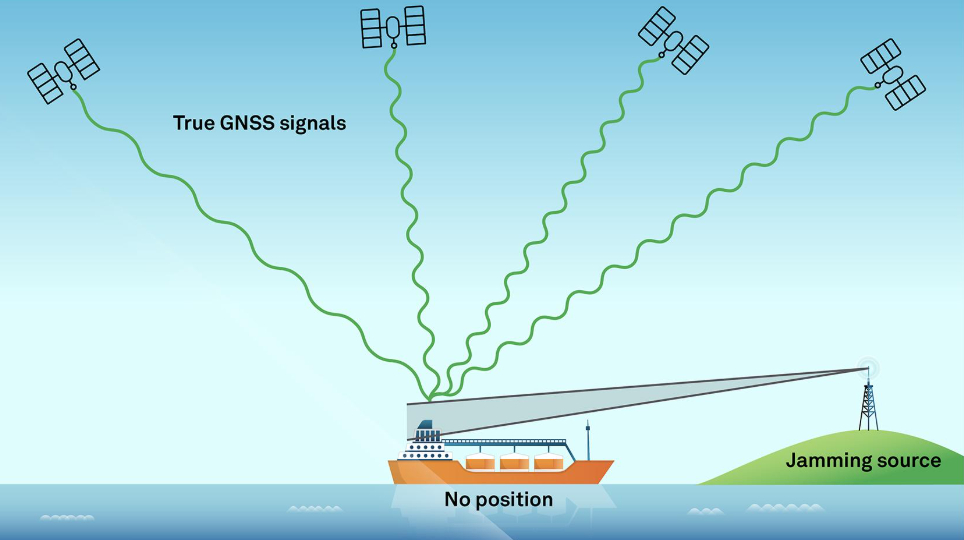
Jamming is a denial-of-service attack on your GNSS receiver. A jammer broadcasts radio frequency noise across the GNSS frequency bands (L1, L2, L5, etc.), overpowering the legitimate satellite signals. Your receiver can’t hear the satellites anymore — it simply loses its fix.
Key characteristics of jamming:
- Your receiver knows something is wrong. It reports a loss of signal or poor signal quality.
- It’s relatively unsophisticated — cheap jammers are widely available and are often used by truck drivers trying to defeat fleet tracking systems.
- The effect is local (typically a radius of a few hundred metres to a few kilometres depending on power).
- Detection is straightforward: a sudden drop in C/N₀ (carrier-to-noise ratio) across all satellites simultaneously is a classic jamming signature.
Real-world impact: A jammed system fails visibly. Navigation stops. Systems fall back to dead reckoning or raise an alert. It’s disruptive — but at least you know about it.
What is GNSS Spoofing?
Spoofing is far more dangerous. Instead of blocking satellite signals, a spoofer replaces them with counterfeit signals that your receiver accepts as legitimate. The receiver calculates a position — it’s just the wrong one.
Key characteristics of spoofing:
- Your receiver thinks everything is fine. It reports a healthy fix with good signal quality.
- The attacker has full control over where your receiver thinks it is — and can move that position gradually to avoid triggering alarms.
- Detection requires either multi-constellation/multi-frequency receivers, inertial sensor fusion, or cryptographic signal authentication (e.g. Galileo’s OS-NMA service).
- Sophisticated spoofing attacks can fool entire fleets simultaneously.
Real-world impact: Spoofed systems fail silently. A vessel navigating into the wrong shipping lane, a drone being redirected to a hostile location, a timing signal in a power grid being shifted — none of these trigger an obvious alarm. That’s what makes spoofing so serious.
A Quick Comparison
| Jamming | Spoofing | |
|---|---|---|
| Mechanism | Overwhelms signal with noise | Replaces signal with fake one |
| Receiver behaviour | Loses fix, raises alert | Maintains fix, no alert |
| Detectability | Relatively easy | Difficult without countermeasures |
| Sophistication required | Low | Moderate to high |
| Primary risk | Disruption | Misdirection |
| Typical mitigation | Robust antenna, multi-band receiver | Signal authentication, IMU fusion, multi-constellation |
Where Are These Threats Happening Right Now?
Jamming and spoofing incidents have grown dramatically in recent years:
- The Baltic Sea and Eastern Europe have seen widespread GPS jamming affecting commercial aviation and maritime traffic, traced to military activity near conflict zones.
- The Black Sea has been an ongoing hotspot for GNSS spoofing since at least 2017, with vessels reporting false positions placing them at Sochi airport.
- The Middle East sees routine spoofing around certain airports, disrupting commercial flight management systems.
- Urban environments increasingly deal with low-level jamming from personal privacy devices (PPDs) — illegal in most jurisdictions but widely used.
This is no longer an edge case. If your system operates anywhere near geopolitical friction or high-density urban areas, you need to assume you will encounter both threats.
What Should Engineers Do?
For anti-jamming:
- Use a high-quality multi-band antenna with good ground plane isolation
- Monitor C/N₀ values in real time and log anomalies
- Implement automatic gain control (AGC) monitoring — a sudden AGC drop is an early jamming indicator
- Consider a multi-constellation receiver (GPS + Galileo + GLONASS + BeiDou) — jamming all bands simultaneously is harder
For anti-spoofing:
- Enable Galileo’s Open Service Navigation Message Authentication (OS-NMA) if your receiver supports it
- Fuse GNSS with an IMU — inertial data is impossible to spoof remotely
- Monitor for inconsistencies: signal level too high, too many satellites with perfect SNR, position jumps that disagree with velocity — these are red flags
- Use a receiver with built-in spoofing detection (some u-blox and Septentrio modules include this)
- For timing-critical applications, cross-check against an independent time source
The Bottom Line
Jamming is a blunt instrument. It causes obvious failures and is relatively easy to detect and mitigate. Spoofing is a precision weapon — it exploits your system’s trust in GNSS and can cause failures you won’t notice until serious damage is done.
Both threats are real, both are growing, and both require different engineering responses.
If you’re unsure how resilient your system is to either threat, that’s exactly what we’re here to help with. Our team has 20+ years of hands-on GNSS experience, from hardware integration through to live environment testing.
Linfinity GNSS is a Cambridge-based team of precision positioning engineers specialising in GNSS integration, anti-jam, and anti-spoof systems. We work with organisations across maritime, defence, and autonomous systems.
Leave a Reply