
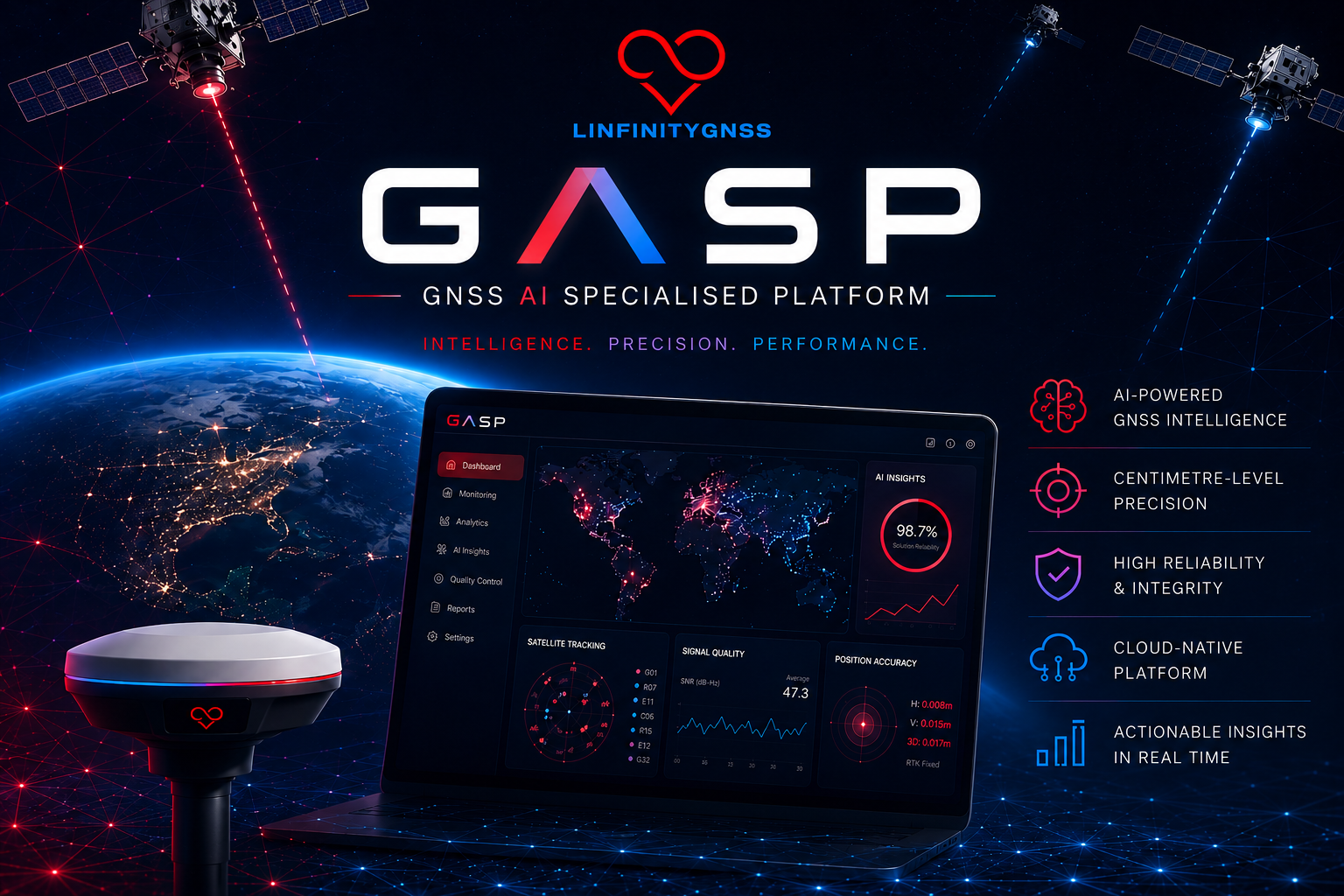
Get instant, free answers to your GNSS questions from our AI Expert — A new AI is coming soon. We’re building the next generation of the platform — GASP — bringing even deeper GNSS expertise and sharper analysis to every interaction. Stay tuned.
- “What’s the difference between RTK and PPP correction?”
- “How accurate is GNSS positioning in urban environments?”
- “Which service fits a survey-grade application?”
See what manual GNSS troubleshooting is really costing you — before and after GASP.
Wondering how much you could save?
See exactly how much time and budget an AI GNSS expert can save your team, based on your own setup — free, instant, no obligation.
Calculate Your Savings Takes under a minute — no sign-up requiredAsk GASP anything about GNSS
GASP is our own AI GNSS expert, built specifically to answer the kind of technical questions that usually take an email thread from a few days to months to resolve.
Instead, you get a considered answer in seconds, any hour of the day, without waiting on someone’s inbox — drawing on the same depth of GNSS knowledge our engineering team works from, distilled into something you can query directly.
Why we built an AI GNSS expert
Most technical questions in GNSS aren’t complicated once someone who actually knows the field explains them — the problem is usually just getting to that person quickly enough.
An engineer evaluating a receiver at 11pm. A founder untangling RTK versus PPP before a client call. A student making sense of multipath error. None of these should have to wait until Monday morning for a reply.
GASP exists to close that gap — giving anyone a genuinely useful first answer immediately, with our human team standing behind it for anything that needs deeper, hands-on expertise.
Ask a direct question
Type your question exactly as you’d ask a colleague — no special phrasing required.
Get a grounded answer
Our AI GNSS expert draws on real GNSS engineering knowledge, not generic web content, for an accurate response.
Go deeper if you need to
If your question needs a human engineer, it says so — and connects you to our team.
What you can ask GASP about
Correction methods
RTK, PPP, SBAS, and how to choose the right correction approach for your application and environment.
Accuracy and error sources
Multipath, atmospheric delay, urban canyon effects, and what actually limits real-world positioning accuracy.
Receiver and antenna selection
Trade-offs between receiver types, antenna placement, and what matters for your particular use case.
Timing and synchronisation
1PPS, UTC referencing, and how GNSS timing infrastructure fits into wider system design.
GASP gives you professional-grade GNSS advice whenever you need it, without waiting on an email reply. It’s not a replacement for deep, project-specific engineering work — but it’s a genuinely useful starting point, and it gets better with every question it answers.
Can’t fully resolve what you’re asking? It’ll say so, and point you toward our human team rather than guessing.
Grounded in the wider GNSS field
GNSS is a fast-moving field, and no single source holds the whole picture. An AI assistant is a good first stop, but it works best alongside the wider body of public GNSS knowledge that engineers already rely on.
These are excellent places to dig into constellation details, signal structures, and the historical context that a single conversation can’t fully cover — particularly the IGS if you’re working with PPP corrections or need to understand how reference frames are maintained.
We treat these as complementary, not competing. Read around a topic there, then bring the specific, applied version of your question back to GASP — that combination gets you further than relying on either approach alone. A genuinely useful GNSS assistant should point you outward as often as it pulls you in.
Question not answered?
Contact our team →Frequently Asked Questions
No. Ask in plain language and it will meet you at your level, whether you’re a specialist engineer or just starting to learn about GNSS.
It draws on real GNSS engineering knowledge rather than generic web content, so answers are grounded and specific — though it will always point you to our human team for anything genuinely complex or project-specific.
Not entirely. It’s an excellent first stop for technical questions, but deep, hands-on project work still benefits from a real conversation with our team.
Not automatically. It answers based on general GNSS expertise, so the more detail you include in your question, the more useful the answer will be.
It will tell you directly rather than guessing, and point you to our contact page so a human engineer can pick it up from there.