

By Linfinity GNSS | 6 min read
Most engineers think of GNSS as a positioning technology. You put a receiver in a device, it figures out where it is, and you use that location for navigation or tracking. Simple enough.
But there’s an entire class of GNSS receiver that doesn’t care where it is at all. Its only job is to know exactly what time it is — to within nanoseconds (only using 1 satellite).
These are timing GNSS receivers, and they underpin more of modern infrastructure than most people realise.
Why GNSS is a Time Technology First
Here’s something that surprises a lot of people: GNSS is fundamentally a timing system. Every satellite in a GNSS constellation carries an atomic clock and continuously broadcasts a timestamped signal. Your receiver calculates its position by measuring the tiny differences in arrival time between signals from multiple satellites (TOA) — and from those differences, computing where in space it must be for those delays to make sense.
Position is derived from time. Not the other way around.
This means a GNSS receiver with a known, fixed position can skip the positioning calculation entirely and focus entirely on extracting the most precise time signal possible. That’s exactly what a timing receiver does.
What Makes a Timing Receiver Different?
A standard GNSS receiver and a timing receiver might use the same satellite signals, but they’re optimised for completely different outputs.
| Standard GNSS Receiver | Timing GNSS Receiver | |
|---|---|---|
| Primary output | Position (lat/lon/alt) | Time (UTC or GNSS time) |
| Typical accuracy | 1–5 metres | 10–100 nanoseconds |
| Antenna | Often mobile, patch antenna | Fixed, surveyed-in position |
| Clock discipline | Basic | Steers an external oscillator (OCXO or Rubidium) |
| Key output signal | NMEA position sentences | 1PPS (one pulse per second) |
| Use case | Navigation, tracking | Synchronisation, frequency reference |
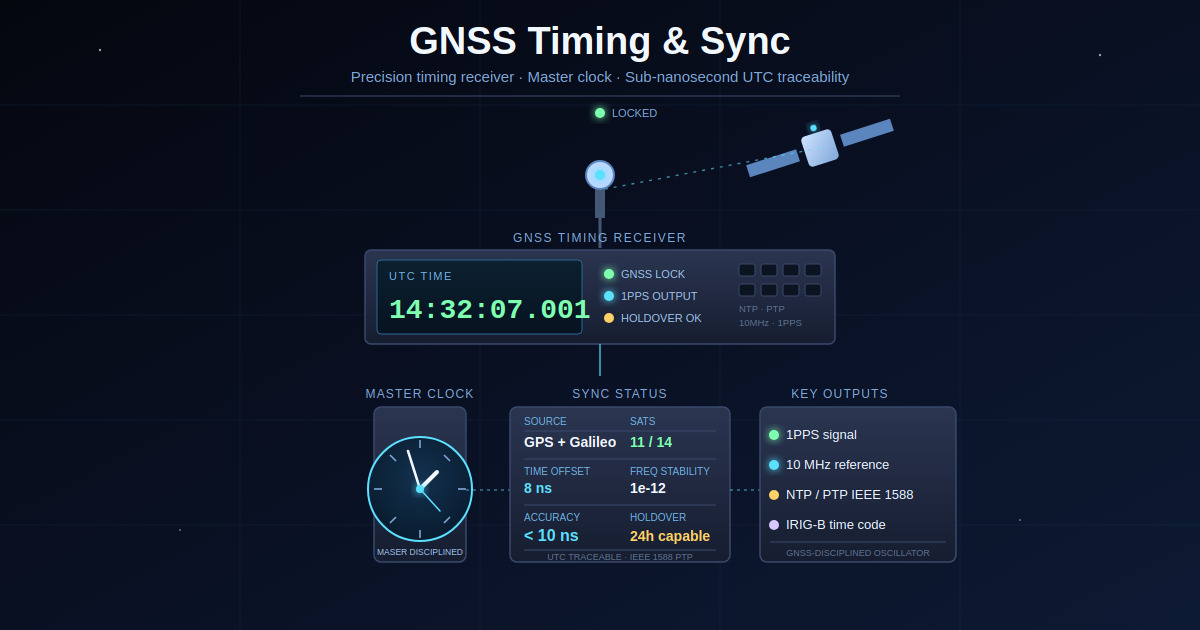
The most important output of a timing receiver isn’t a coordinate — it’s the 1PPS signal: a single electrical pulse fired precisely on the second, every second, aligned to UTC. That pulse is what other systems lock onto.
What is 1PPS and Why Does It Matter?
A 1PPS (one pulse per second) signal is a hardware output — typically a 3.3V or 5V TTL pulse on a coaxial connector — that fires at the exact turn of each UTC second. The leading edge of the pulse is aligned to within tens of nanoseconds of true UTC.
Systems that need to be precisely synchronised — whether that’s two base stations in a telecom network or two sensors in a test range — can lock to the same 1PPS source and know they’re operating on the same timebase.
Think of it as a heartbeat for your infrastructure.
Where Are Timing GNSS Receivers Used?
The range of applications is broader than most people expect:
Telecommunications Mobile networks (4G/LTE, 5G) require base stations to be synchronised to within microseconds of each other. Timing receivers provide the UTC reference that keeps the whole network coherent. Without them, handoffs between cells fail and data packets collide.
Power grids Synchrophasors — devices that measure voltage and current phase across a power grid — must be timestamped with sub-microsecond accuracy to be useful. GNSS timing receivers provide that reference across geographically distributed substations.
Financial trading Regulatory frameworks (MiFID II in Europe, for example) require financial transactions to be timestamped to 100-microsecond accuracy or better. Trading systems use GNSS timing to comply and to resolve disputes about trade sequencing.
Test and measurement When you’re testing RF systems, radar, or communications equipment across multiple sites, you need a shared time reference. Timing receivers let distributed test equipment correlate measurements that were taken kilometres apart.
Data centres and distributed computing Accurate timestamps matter for database consistency, log correlation, and security certificate validation. GNSS timing feeds into network time infrastructure (PTP/IEEE 1588 or NTP) to keep server clocks honest.
Defence and SIGINT Direction finding, time-difference-of-arrival (TDOA) localisation, and electronic warfare all require precise time synchronisation across sensor networks.
The Role of the Oscillator
A timing receiver doesn’t just output 1PPS and leave it there. In most professional deployments, it also disciplines an oscillator — typically a temperature-compensated crystal oscillator (TCXO), oven-controlled crystal oscillator (OCXO), or Rubidium atomic clock.
Why? Because GNSS signals can be interrupted — by jamming, multipath, or simply a blocked sky view. When the GNSS signal is lost, the disciplined oscillator holds over, maintaining the timing reference using its own stability until GNSS is reacquired.
The quality of that holdover — how long the system can maintain accuracy without GNSS — is a critical spec for any resilient timing deployment. A basic TCXO might drift by microseconds within minutes. A Rubidium oscillator can hold nanosecond-level accuracy for hours.
Vulnerabilities: Timing Receivers and Spoofing
Because timing receivers are often fixed-position and deeply embedded in infrastructure, they present a specific spoofing risk that’s worth understanding.
An attacker who can spoof a timing receiver doesn’t need to move it — they just need to shift its time reference. Even a few microseconds of error injected into a telecom network’s timing can cause widespread service degradation. A few hundred microseconds can take down synchronised trading systems.
Unlike navigation spoofing (where position jumps are detectable), timing spoofing can be extremely subtle — shifting time gradually over hours to stay below alarm thresholds.
Mitigations include:
- Multi-constellation, multi-frequency receivers (harder to spoof all signals simultaneously)
- Galileo OS-NMA authentication
- Cross-checking against PTP grandmaster clocks or Caesium references
- Monitoring for abnormal signal characteristics even when the fix appears healthy
Choosing a Timing Receiver: Key Specs to Check
If you’re specifying or integrating a timing GNSS receiver, here are the parameters that matter:
- Time accuracy (RMS and peak): How close is the 1PPS to true UTC under normal conditions?
- Holdover performance: How does the system behave when GNSS is lost? What oscillator is used?
- Multi-constellation support: GPS only, or GPS + Galileo + GLONASS + BeiDou? More constellations means better accuracy and resilience.
- Frequency output: Does it also output a 10 MHz reference signal? Useful for disciplining lab instruments.
- Form factor: Rack-mount, DIN rail, or embedded module?
- Anti-spoof/anti-jam features: Especially important for infrastructure deployments.
Common platforms include the u-blox LEA-M8F and ZED-F9T modules at the embedded end, and rack-mount units from Microsemi (now Microchip), Trimble, and Meinberg at the infrastructure end.
The Bottom Line
A timing GNSS receiver is not a navigation device. It’s a precision time source — one that keeps telecoms networks running, power grids stable, financial markets compliant, and distributed sensor systems coherent.
If your system depends on accurate timestamps, synchronised measurements, or any form of distributed coordination, you almost certainly have timing GNSS receivers somewhere in your stack. Understanding how they work — and how they can fail — is increasingly essential engineering knowledge.
If you’re integrating, testing, or securing a timing-dependent system and need expert support, we’re here to help.
Talk to a GNSS timing expert → (AI) or send us an email to:
info@linfinityGNSS.com
Linfinity GNSS is a Cambridge-based team of precision positioning and timing engineers with 20+ years of hands-on experience. We support organisations across telecoms, defence, maritime, and autonomous systems.
Leave a Reply