
Advanced anti-jam & anti-spoof expertise for detecting jamming and spoofing threats across maritime, automotive, and industrial positioning systems.
The hidden backbone of our navigation systems.
GNSS signals are remarkably weak by the time they reach a receiver — often compared to viewing a car headlight from thousands of miles away. That weakness makes them vulnerable, which is exactly why advanced anti-jam & anti-spoof capability has become a core requirement rather than an afterthought. A cheap jammer can drown out satellite signals in seconds, and a well-crafted spoofing attack can feed a receiver false coordinates without it ever knowing something’s wrong.
As positioning systems become critical infrastructure — guiding ships, vehicles, drones, and industrial equipment — the ability to detect and respond to these threats isn’t optional. It’s foundational to keeping GNSS trustworthy. The US government’s own guidance on GPS jamming outlines why this has become a national-level concern, not just an industry one.
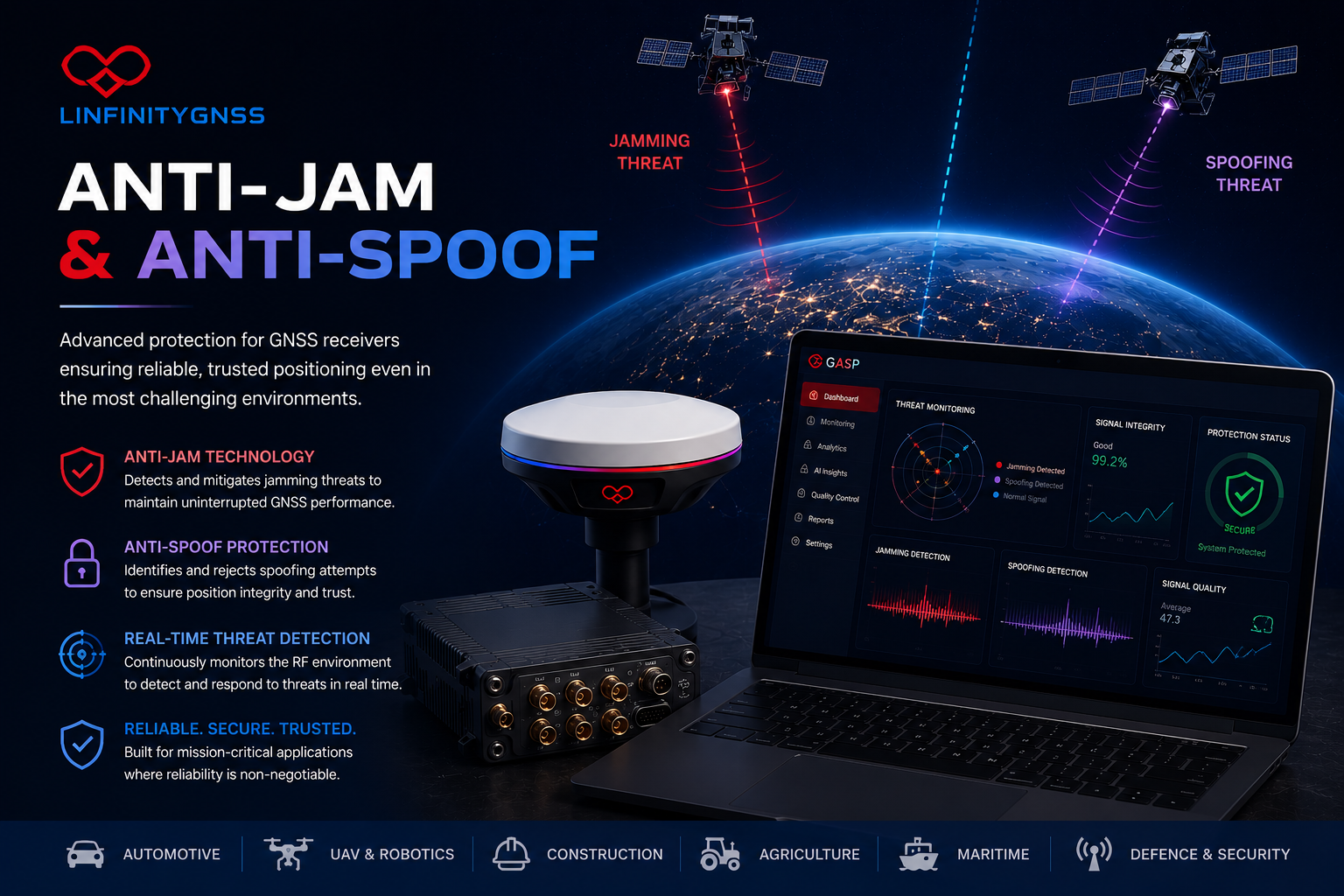
We help organizations understand their exposure to jamming and spoofing, and build the detection and resilience capabilities needed to keep systems trustworthy in contested or degraded signal environments. Our approach draws on real GNSS signal processing knowledge — from carrier-to-noise ratio (C/N0) monitoring to automatic gain control (AGC) behaviour — so that our recommendations are grounded in how receivers actually behave under attack, not just theoretical risk.
To learn more about the wider GNSS technology behind these threats, visit our homepage, read our background articles on the fundamentals of satellite positioning, or see GPS.gov’s overview of how the GPS system works.
The Threat Landscape
Two distinct attack types — and a growing reason both are becoming more common.
Jamming
Deliberate or incidental RF interference that overpowers legitimate GNSS signals, causing a receiver to lose lock entirely. Cheap, widely available, and increasingly common — and the primary reason continuous signal monitoring is needed at the receiver level.
Spoofing
False GNSS signals broadcast to trick a receiver into calculating an incorrect position, velocity, or time — all while appearing to function normally. Detecting this silent failure mode is the hardest part of any advanced anti-jam & anti-spoof strategy.
Why it’s getting worse
Low-cost software-defined radios have lowered the barrier to attack, while more industries depend on GNSS for critical operations, pushing jamming and spoofing resilience from a niche defence concern into mainstream commercial requirements.
What We Help With
Advanced anti-jam & anti-spoof practical support for detecting and defending against threats, wherever your systems operate.
Threat detection & monitoring
Implementing detection techniques to identify signs of jamming or spoofing in real time — including signal anomalies, C/N0 drops, AGC saturation, and position or clock jumps that a properly tuned receiver should never accept without question.
Resilience testing
Simulating jamming and spoofing scenarios to evaluate how your system responds under attack, before it happens in the field — a core part of any resilience validation programme, using controlled RF environments rather than live signal denial.
System hardening
Guidance on mitigation strategies — from controlled reception pattern antennas (CRPA) and antenna design to sensor fusion approaches with inertial and other sensors that reduce reliance on GNSS alone.
Sector-specific solutions
Tailored jamming and spoofing support for maritime navigation, automotive positioning, and industrial systems and their distinct threat profiles, timing requirements, and regulatory expectations.
How Advanced Anti-Jam & Anti-Spoof Detection Works
The technical building blocks behind reliable positioning in contested signal environments.
Effective jamming and spoofing detection rarely relies on a single indicator. Instead, it combines several layers of evidence:
Signal strength & C/N0 trends
Receiver AGC behaviour
Multi-constellation consistency
Cross-validation vs. IMU / wheel-speed
Jamming fingerprint
A broad, sudden drop in signal-to-noise across all visible satellites at once — a clear pattern that’s relatively straightforward to flag.
Spoofing fingerprint
Harder to catch: a competent attacker can produce signals that look statistically normal, so detection also leans on timing discontinuities, odd Doppler shifts, and implausible velocity or acceleration jumps.
Once a threat is flagged, the response follows a chain:
Alert
Operator is notified that something looks wrong.
Down-weight or exclude
Suspect satellites are discounted in the position solution.
Fall back
Dead-reckoning from other sensors until clean signals return.
Designing that response chain — deciding what to trust, what to discard, and when to alert a human — is where most of our advanced anti-jam & anti-spoof consulting work happens. You can find more detail on our approach via our main site.
Who Needs This
Any organization where positioning integrity directly affects safety, security, or operations needs a working defence against jamming and spoofing — ship operators navigating contested waters, automotive manufacturers building autonomous or ADAS systems, and industrial operators relying on precise timing and location for critical infrastructure such as power grids and telecoms networks. If GNSS underpins a safety case or a service-level agreement, advanced anti-jam & anti-spoof resilience belongs in the design from day one, not bolted on afterwards.
Why It Matters
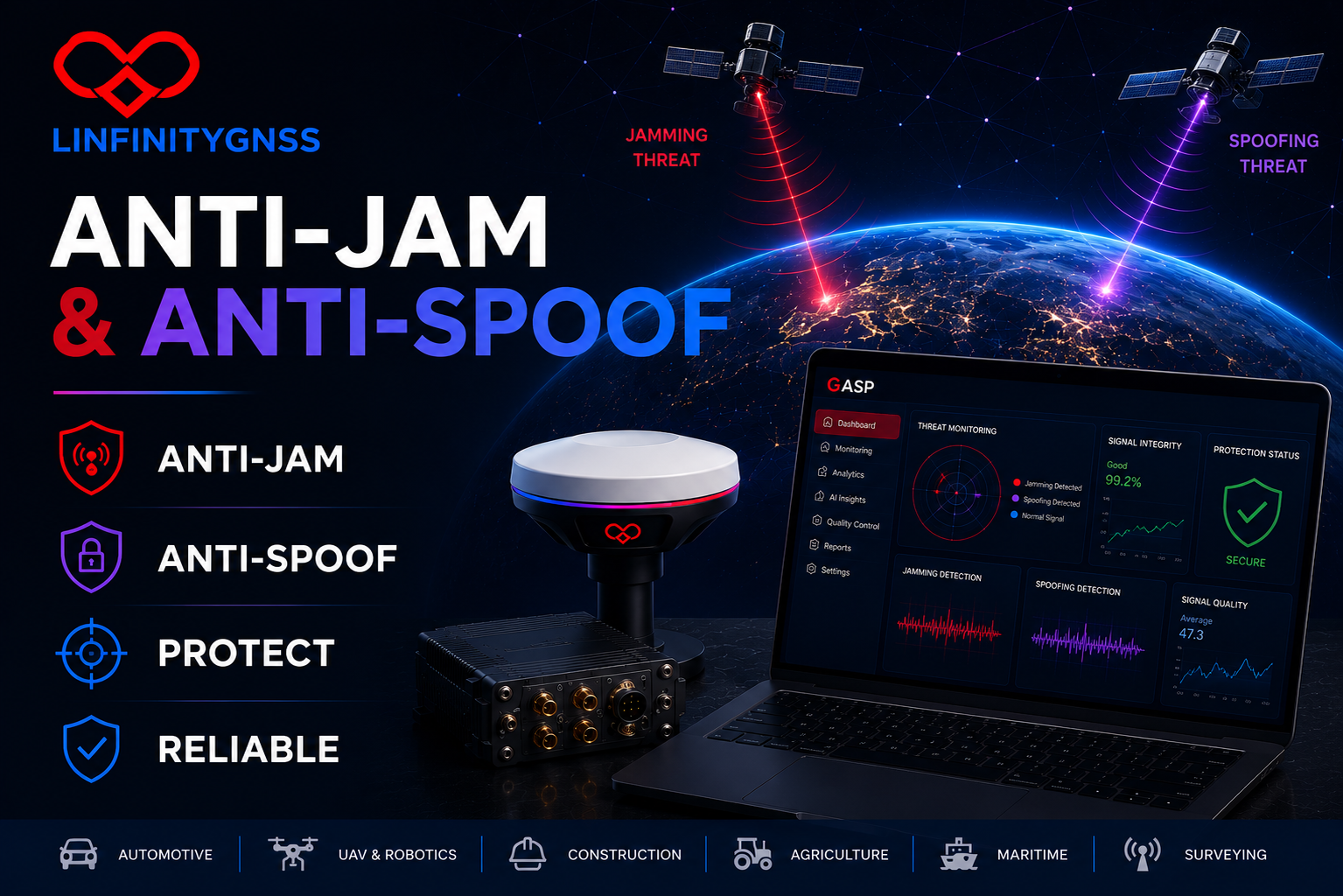
A positioning system that silently accepts bad data is more dangerous than one that simply fails — because nothing tells the operator that something is wrong. Building advanced anti-jam & anti-spoof capability to detect and respond to these threats isn’t just a technical safeguard; it’s what allows organizations to trust their systems when it matters most.
As regulators and standards bodies increasingly reference this kind of resilience as an expected baseline for safety-critical positioning, getting ahead of the requirement is far cheaper than retrofitting it after an incident. Explore more of our thinking on GNSS resilience at linfinitygnss.co.uk.
Get Started
Concerned about your system’s exposure to jamming or spoofing? Talk to us about detection and resilience.
Loading contact email… Learn more about our GNSS resilience services →