

GNSS receivers are designed to recover extremely weak signals from satellites millions of kilometres away. That makes them inherently vulnerable to radio-frequency interference: a nearby interferer does not need to reproduce a GNSS signal to cause damage. It only needs to raise the interference environment at the receiver input enough to reduce tracking margin, desensitize the front end, or prevent acquisition and tracking altogether.
The engineering response is not simply to buy an “anti-jam antenna”. Resilient PNT is a system property. Antenna architecture, RF filtering, receiver dynamic range, interference detection, adaptive processing, firmware, installation, and—where required—independent sensors and holdover all contribute to the outcome.
This guide explains the differences between a conventional fixed-reception-pattern antenna (FRPA), pattern-shaped antennas, and controlled-reception-pattern antennas (CRPAs); explains why CRPA performance depends on the antenna electronics and receiver architecture; and provides a practical framework for selecting the appropriate level of protection.
1. Standard Antennas vs. Anti-Jamming Antennas: What Actually Changes?
A conventional GNSS antenna has a fixed spatial reception pattern. It may be a simple patch, a more sophisticated precision antenna, or a multi-band design with filtering and a low-noise amplifier. Its pattern is determined by the antenna geometry, ground plane, radome, installation, and RF design. Once manufactured and installed, that pattern does not adapt in real time to the direction of an interferer.
That distinction matters because the antenna does not intrinsically know whether an RF signal is legitimate or hostile. A jammer arriving from an azimuth and elevation inside the antenna’s useful reception region is simply another RF input. If the interference is strong enough, the receiver may lose carrier tracking, suffer front-end compression or saturation, or experience a rise in the effective noise floor.
A CRPA takes a fundamentally different approach. Instead of relying on a single antenna element, it uses multiple spatially separated elements whose signals are processed coherently. The system can estimate the spatial characteristics of interference and apply complex weights to the element signals. The resulting array response can place deep spatial nulls toward one or more interferers while retaining useful sensitivity to GNSS signals.
The important point is that a CRPA does not simply ‘block the jammer’. It changes the spatial weighting of the received signals before the receiver processes them as GNSS measurements. The exact architecture varies between products: some systems emphasize null steering, some combine nulling and beamforming, and some integrate additional interference detection or filtering.
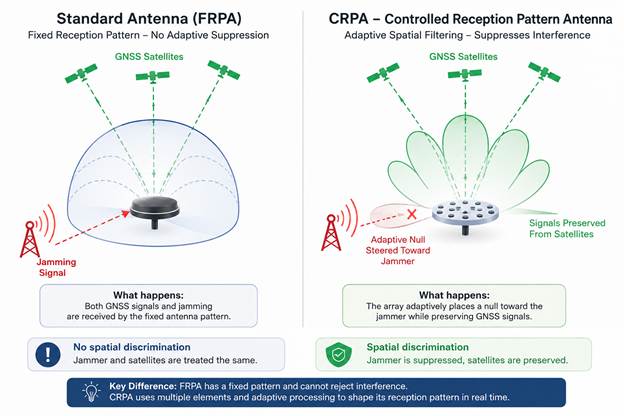
Figure 1 — Fixed reception versus adaptive spatial filtering. The CRPA concept is shown as an adaptive spatial response with a null directed toward the interferer.
One terminology point is worth making: an FRPA should not be described as having ‘equal gain in every direction’. Real GNSS antennas have elevation and azimuth-dependent gain, polarization characteristics, multipath sensitivity, and often deliberate pattern shaping. The defining property of an FRPA is that its spatial response is fixed—not that it is perfectly isotropic.
2. There Is a Middle Ground: Pattern-Shaped Antennas
Between a conventional antenna and a full CRPA there are antennas designed to reduce interference through a fixed spatial pattern. Choke rings, optimized ground planes, low-elevation suppression, and out-of-band filtering can all reduce the amount of unwanted energy reaching the receiver.
This works well when the interference geometry is predictable. For example, suppressing low-elevation signals can reduce the impact of a ground-based jammer while preserving most of the useful GNSS sky view.
But the pattern is fixed. If the jammer moves, the antenna cannot move the rejection zone with it. Pattern shaping reduces vulnerability by design; a CRPA adapts to the interference in real time.
| Architecture | Spatial response | Interference discrimination | Typical complexity |
| FRPA | Fixed | None beyond the inherent antenna pattern | Low |
| Pattern-shaped antenna | Fixed, deliberately shaped | Limited and geometry-dependent | Low–moderate |
| CRPA | Adaptive | Dynamic nulling and/or beamforming | Moderate–high |
3. Why the Antenna Is Only Part of the Anti-Jam System
The term anti-jam antenna can be misleading. With a conventional GNSS antenna, the antenna is primarily the RF interface between the sky and the receiver. In a CRPA system, the antenna array is only one part of a larger signal-processing chain.
Each array element provides a separate RF signal. These signals must then be calibrated, combined, and weighted to create the desired spatial response. The quality of this processing ultimately determines how much of the array’s theoretical interference-rejection capability can be achieved in practice.
This also makes system compatibility critical. Depending on the architecture, multiple RF paths may connect the array to a separate antenna-electronics unit, or the CRPA may integrate the processing and provide a conventional RF output to the host receiver. Understanding where the adaptive processing takes place—and what the host receiver actually receives is essential.
For example, Antcom specifies compatible antenna electronics for its CRPA arrays, while NovAtel’s GAJT family supports architectures where the CRPA and null-forming electronics can be integrated or separated. These represent different system architectures and should not be treated as interchangeable.
4. The Receiver Still Matters
A CRPA can protect the RF input, but it does not make the receiver immune to interference. Receiver architecture remains critical because strong adjacent-band or in-band signals can challenge the RF front end, filters, amplifiers, mixers, ADCs, automatic-gain-control loops, and tracking algorithms.
Modern GNSS receivers can add significant resilience through wide dynamic range, RF filtering, interference detection, adaptive or notch filtering, spectral monitoring, robust signal processing, and firmware-level mitigation. These techniques do not replace a CRPA in every threat environment, but they can make a substantial difference where the interference level is moderate or the platform cannot tolerate CRPA size, weight, power, and cost.
This leads to a better engineering question than ‘Which anti-jam antenna should I buy?’: ‘What level of interference protection does the complete GNSS architecture need, and where should that protection be implemented?’
5. Jamming, Interference and Spoofing Are Not the Same Problem
The terms interference, jamming, and spoofing are often used interchangeably, but they represent different engineering problems. Jamming is primarily an availability problem; spoofing is an integrity and trust problem.
| Threat | What it does | Typical objective | Primary mitigation |
| Unintentional interference | Adds unwanted RF signal or raises the noise floor | Degrade GNSS performance | Filtering, dynamic range, interference monitoring |
| Jamming | Deliberately overwhelms GNSS signals | Deny or degrade availability | Spatial nulling, filtering, robust processing |
| Spoofing | Transmits counterfeit GNSS-like signals | Mislead the PNT solution | Authentication, consistency checks, sensor fusion |
A CRPA is primarily an interference-mitigation technology, not an authentication mechanism. It can improve resilience against some jamming and spoofing scenarios through spatial discrimination, but it does not guarantee that interference will be rejected.
Its effectiveness depends on array geometry, calibration, interference direction, signal environment, and adaptive processing. In some conditions, a CRPA can produce an imperfect null, suppress desired GNSS signals, or even increase the effective gain toward an interferer.
A CRPA provides spatial degrees of freedom; it does not guarantee spatial protection. And while it can reject a signal based on where it comes from, it cannot determine by direction alone whether that signal is authentic.
6. How Many Jammers Can a CRPA Suppress?
This is one of the most misunderstood specifications on an anti-jam datasheet.
A common rule of thumb is that an N-element array provides N−1 spatial degrees of freedom for interference suppression when one constraint is reserved for maintaining the desired GNSS response. This is a useful concept, but it does not mean N−1 jammers can always be perfectly rejected.
For example, a four-element array should not automatically be interpreted as being capable of suppressing three jammers under all conditions. Practical performance depends on array geometry, calibration, frequency, jammer separation, bandwidth, algorithm, dynamic range, and GNSS signal preservation. Closely spaced or broadband interferers, strong near-field sources, calibration errors, and platform scattering can significantly reduce effective suppression.
When evaluating a vendor specification, always ask for the test conditions: frequency and bandwidth, interference waveform and power, number and angular separation of interferers, static or dynamic scenario, and whether the result is measured as null depth at the array output or end-to-end GNSS/PNT performance.
7. Matching Protection to the Application
There is no universal ‘best’ anti-jam antenna. Protection should be sized against three things: the threat, the consequence of losing trustworthy PNT, and the platform’s size/weight/power/cost constraints.
| Application | Typical exposure | Practical architecture | Main constraint |
| Consumer IoT / asset tracking | Low to moderate; mainly unintentional interference | Good FRPA + receiver interference detection | Cost and power |
| Automotive / fleet telematics | Urban RF congestion, multipath, occasional jamming | High-quality multi-band FRPA + receiver mitigation and monitoring | Cost, integration, packaging |
| Timing infrastructure | Moderate exposure; very high outage consequence | High-performance antenna + filtering/receiver mitigation; consider CRPA where threat warrants | Availability, long life, holdover |
| Surveying / RTK / precision agriculture | Moderate; interference can corrupt availability and measurement quality | Multi-band FRPA or CRPA according to site risk + receiver mitigation | Accuracy, cost, field practicality |
| Maritime | Moderate to high; RF congestion and deliberate interference possible | Pattern-shaped or CRPA depending on threat; robust monitoring | Marine environment, installation |
| UAV / robotics | Moderate to high; SWaP is critical | Compact CRPA or advanced receiver-level mitigation | Size, weight and power |
| Defence / assured PNT | High; deliberate and adaptive threats | CRPA + resilient receiver + monitoring + complementary PNT | Mission assurance rather than unit cost |
The right choice should be driven by the level of threat and the consequences of losing GNSS. A high-end CRPA can be unnecessary overengineering for a low-value tracker, while a basic FRPA may leave a safety- or mission-critical platform dangerously exposed to deliberate, high-power interference. The antenna architecture should match the threat—not simply the product price or performance headline.
8. Why Monitoring Still Matters When You Have a CRPA
Protection without visibility is incomplete. A GNSS receiver can be significantly degraded before it reports a complete loss of position, and it may continue producing a plausible PVT solution while measurement quality is deteriorating. Useful indicators include:
- AGC or RF-level indicators — reveal changes in the interference environment and unexpected increases in received power.
- C/N₀ trends — expose loss of signal margin and abnormal degradation across satellites.
- Spectrum and interference monitoring — helps distinguish narrowband, broadband, swept, and other RF disturbances.
- Jamming/interference flags — provide a simple, machine-readable indication for system-level decision logic.
- Integrity and consistency monitoring — essential for detecting conditions where the solution remains available but may no longer be trustworthy, particularly under spoofing.
But detection alone is not enough. Every alarm should trigger a defined response. Depending on the application, the system may switch navigation modes, increase reliance on inertial sensors, reject suspect measurements, change its timing source, alert the operator, or transition to a controlled degraded mode.
A resilient GNSS system does not just detect that something is wrong—it knows what to do next.
9. Testing: Do Not Buy the Number on the Datasheet
Anti-jam performance is highly scenario-dependent. A single quoted ‘dB of suppression’ or ‘number of jammers’ is not enough to compare two systems.
A meaningful evaluation should define the GNSS bands under test, interference waveforms, jammer power, jammer-to-signal ratio, angular geometry, number of simultaneous interferers, polarization, platform dynamics, and success criteria.
Laboratory testing can be conducted through conducted RF paths or over-the-air testing. Conducted testing is useful for receiver and signal-processing development, while radiated/OTA testing is necessary when the antenna array, spatial response, installation, and coupling between elements are part of the performance claim. Keysight’s current CRPA testing guidance also emphasizes the need to reproduce realistic NAVWAR conditions rather than relying on a single simplistic interferer.
For a serious procurement, ask for test evidence—not just marketing terminology. The most useful result is a system-level demonstration showing that the receiver continues to acquire and track authentic GNSS signals and maintains acceptable PNT performance under defined interference conditions.
10. Vendor Landscape: Understand What You Are Actually Buying
The market is easiest to understand when divided into two broad groups: vendors providing CRPA/anti-jam antenna systems, and receiver or chipset vendors implementing interference mitigation inside the GNSS receiver. Some companies operate in both spaces.
Antenna and CRPA system providers EXAMPLES
| Vendor / family | Positioning in the market | What to look at |
| Antcom CRPAs | Dedicated CRPA arrays for assured PNT | Element count, frequency coverage, antenna-electronics compatibility, SWaP |
| Hexagon | NovAtel GAJT | Integrated and federated anti-jam systems across land, marine and airborne platforms | Nulling capability, protected bands, form factor, receiver compatibility, direction finding |
| Calian / Tallysman | GNSS antennas, pattern shaping and CRPA solutions | Filtering, low-SWaP options, element architecture and integration |
Receiver and chipset-level resilience EXAMPLES
| Vendor / technology | Approach | Best understood as |
| Septentrio AIM+ | Hardware filtering and receiver-side interference monitoring/mitigation | Receiver-level resilience and visibility |
| u-blox | Receiver architecture and signal-processing techniques for interference resilience across product families | Low-SWaP receiver-side mitigation; capability varies by device |
| Unicore NebulasIV / JamShield | Integrated multi-frequency anti-jamming and spoofing detection in selected high-precision modules | SoC/module-level resilience |
| Quectel | GNSS jamming detection features in selected modules; product capabilities vary | Monitoring and module-level detection rather than a universal CRPA replacement |
The important comparison is not simply vendor versus vendor. It is architecture versus architecture. A CRPA system with strong spatial suppression can be the right answer for a contested environment; a receiver with strong interference mitigation may be the better answer for a mass-market product; and a high-quality antenna plus filtering and monitoring may be sufficient for a timing installation whose dominant threat is adjacent-band interference.
11. Questions to Ask Before Selecting an Anti-Jam Solution
- What is the actual threat: adjacent-band interference, unintentional RF, consumer jamming, deliberate narrowband jamming, broadband jamming, spoofing, or a combination?
- What is the consequence of losing GNSS availability—or worse, accepting an incorrect PNT solution?
- Which GNSS constellations and frequencies must remain usable during the interference event?
- How many simultaneous interferers must the system handle, and under what geometry?
- Is the CRPA supplied as an antenna array only, or does it include antenna electronics and null-forming processing?
- Is the output compatible with the intended receiver, and what calibration/configuration is required?
- What are the actual SWaP and thermal requirements?
- How is performance specified: suppression in dB, maximum J/S, tracking threshold, PVT continuity, or another metric?
- Were the claims validated with realistic waveforms and multiple interferers, or only with a laboratory CW signal?
- What RF-health and integrity indicators are available to the host system?
- What happens when interference is detected—alarm only, mitigation, navigation-mode change, or automatic sensor fallback?
- What independent PNT sources are available if GNSS becomes unavailable or untrustworthy?
12. Common Anti-Jam Deployment Mistakes
“We installed a CRPA, but the performance did not improve.”
Check the complete signal chain: array, antenna electronics, receiver compatibility, calibration, cabling, firmware, and installation. A CRPA is a system, not simply a different antenna connector.
“The datasheet says three jammers, so we are protected against three jammers.”
Ask for the exact test conditions. Spatial separation, waveform, bandwidth, frequency, power, polarization, and platform effects can materially change performance.
“Our receiver still has a position, so GNSS is fine.”
A valid PVT output does not prove that the measurements are trustworthy. Monitor RF conditions, signal quality, integrity and cross-sensor consistency.
“Anti-jam means anti-spoof.”
It does not. Spatial filtering can help in some spoofing geometries, but authentication and integrity require additional techniques.
“More nulls must always mean a better product.”
Not necessarily. More elements can increase spatial degrees of freedom, but they also affect size, power, calibration complexity, cost, and integration.
“We chose the highest-performance solution.”
The best solution is the one that meets the threat and mission requirement with an appropriate margin—not necessarily the one with the largest array.
13. Frequently Asked Questions
Is a CRPA always better than an FRPA?
No. A CRPA provides a much more powerful spatial interference-mitigation mechanism, but it adds cost, size, power, complexity and integration requirements. For many low- or moderate-threat applications, a high-quality FRPA combined with a resilient receiver and good monitoring is the better engineering solution.
Can a CRPA stop spoofing?
Not by itself. A CRPA can provide spatial discrimination and may reject a spoofer when the spatial geometry is favorable, but spoofing is fundamentally an integrity problem as well as an RF problem. Authentication, signal consistency checks and independent sensors may be required.
How many simultaneous jammers can a CRPA suppress?
A useful first-order concept is approximately one fewer independent null than the number of antenna elements, but practical capability is product- and scenario-dependent. Treat the vendor’s tested performance—not the rule of thumb—as the specification.
Do I need a CRPA if my receiver already has interference mitigation?
Not necessarily. Receiver-side mitigation can be extremely effective against many interference scenarios. A CRPA becomes increasingly valuable when interference is strong, spatially localized, deliberate, multi-source, or capable of overwhelming the receiver front end.
What is the biggest procurement mistake?
Treating the antenna as an isolated component. The correct unit of analysis is the complete PNT chain: antenna, RF front end, receiver, mitigation algorithms, monitoring, installation and fallback sensors.
14. The Takeaway
There is no such thing as a universally ‘best’ anti-jamming antenna. There is only a protection architecture that is appropriate—or inappropriate—for a particular threat and mission.
A conventional FRPA provides a fixed spatial response. Pattern-shaped antennas can reduce susceptibility to interference from particular directions. A CRPA goes further by using multiple antenna elements and adaptive processing to reshape the spatial response in real time, creating nulls toward interference while preserving useful GNSS signals.
But spatial filtering is only one layer. Receiver dynamic range, filtering, interference detection, signal processing, integrity monitoring, inertial sensors, alternative timing sources and operational procedures determine whether a platform actually remains resilient when GNSS is under attack.
The right question is therefore not: ‘Which anti-jam antenna should we buy?’
The right question is: ‘What level of PNT resilience does this application require, what threats must it withstand, and where should that resilience be implemented?’
Sources and Further Reading
- Keysight — CRPA Antennas Explained: Choosing and Testing the Best Anti-Jam Solutions for GPS/GNSS Resilience.
- Keysight — How to Conduct CRPA Anti-Jam Antenna Testing.
- Antcom — CRPAs for Assured Positioning, Navigation and Timing (APNT).
- Hexagon | NovAtel — GNSS Anti-jam Antenna Systems (GAJT) and GAJT product documentation.
- Calian — Resilient GNSS and Anti-Jamming Solutions; CR7712EXF documentation.
- Septentrio — Advanced Interference Monitoring and Mitigation (AIM+).
- Unicore — UM980 / NebulasIV / JamShield product documentation.
- Quectel — GNSS Jamming Detection Application Note for BG95/BG77/BG600L series.
Editorial note: Product capabilities change over time and vary by model, firmware and configuration. Vendor-specific statements in this guide should therefore be checked against the current product documentation before being used as procurement specifications.

Leave a Reply