

The Hidden Power Cost of GNSS Reacquisition
infinitygnss.com
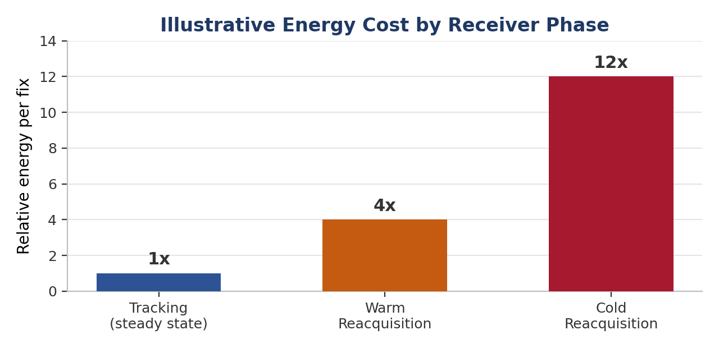
Most GNSS power budgets are built around the receiver’s steady-state tracking current — the datasheet number for “continuous tracking mode.” In the field, that number tells only part of the story. Every time a receiver loses lock and has to find its way back to a fix, it burns far more energy than it does while quietly tracking satellites it already knows about. For battery-powered trackers, wearables, and IoT nodes, this reacquisition penalty is often the single biggest, most overlooked drain on system lifetime.
Acquisition, Tracking, and Reacquisition
- Acquisition — the initial search phase. The receiver sweeps a two-dimensional space of frequency (Doppler) bins against code-phase bins for every satellite in view. Computationally heavy: many correlators, or many sequential search bins.
- Tracking — the steady state. A narrow loop follows small changes in Doppler and code phase, using a fraction of the correlator resources and power that acquisition needs.
- Reacquisition — acquisition’s less forgiving cousin, triggered mid-mission by a signal outage. It’s the phase that quietly dominates power budgets in real deployments.
I
Why Reacquisition Happens So Often
- Urban canyons and foliage repeatedly block and unblock line of sight as a device moves.
- Tunnels and building interiors cause complete signal loss for seconds to hours.
- Multipath / interference can drop carrier-to-noise ratio below the tracking threshold even with a nominally visible satellite.
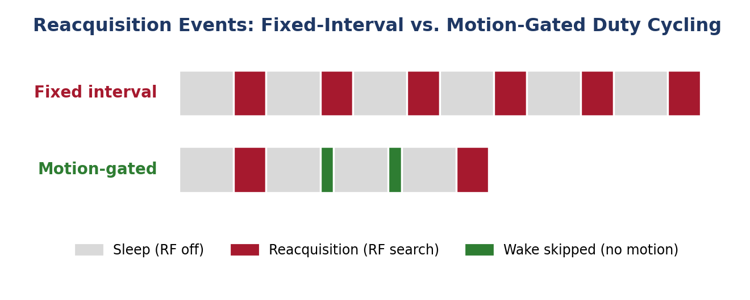
- Aggressive duty-cycling is itself a major cause: powering down the RF front end between fixes means every wake-up is, by definition, a reacquisition — not a continuation of tracking. This creates a direct tension: more aggressive duty-cycling means paying the larger reacquisition cost more often instead of the smaller tracking cost.
Where the Power Actually Goes
- Wider search space — no recent time/ephemeris estimate forces a full Doppler/code-phase sweep, orders of magnitude more correlator work than a warm reacquisition.
- Longer time-to-fix (TTFF) — more search bins and weaker signal both stretch active RF/baseband time, and therefore energy, per fix.
- Repeated partial searches — marginal conditions can cause several failed acquisition attempts before a stable fix, multiplying the energy cost.
- Ephemeris/almanac staleness — valid for ~2–4 hours; a longer sleep forces a full re-download (~18–30+ seconds) in a high-power state.
Duty-Cycling Smarter, Not Just Less
The tracking-vs-reacquisition trade-off is not a hard trade-off- it’s a design decision. A few techniques keep most of the standby savings while shrinking the reacquisition penalty per wake-up:
- Adaptive/variable intervals : shorten sleep when moving quickly (favouring cheap hot starts), lengthen it when stationary or predictable.
- Keeping time, not signal — a disciplined RTC/TCXO through sleep preserves time accuracy, narrowing the Doppler search on wake-up for very little standby current.
- Coarse signal-presence checks — a low-power pre-check before a full search avoids to do attempts when the antenna does not have a good sky view.
- Batching around known outages — scheduling wake-ups to avoid predictable blockage (a daily tunnel, an overnight indoor period).
- Hybrid tracking modes — an intermediate low-power lock state turns “reacquisition” into a cheap return to precision rather than a search from scratch.
Other Levers Worth Engineering For
- A-GNSS assistance data and extended/predicted ephemeris collapse the search space and avoid the re-download tax after long sleeps.
- Sensor fusion / dead reckoning bridges short outages and narrows the search space on wake-up.
- Multi-constellation, multi-frequency receivers and better antenna/RF quality reduce how often lock is lost in the first place — the cheapest fix of all.
The Takeaway
Datasheet tracking current says little about real-world battery life. Reacquisition frequency and cost are usually the real determinant. Power budgets for trackers, wearables, and IoT devices should be built around a realistic reacquisition rate for the target environment – and clever duty-cycling, assistance data, and sensor fusion should be treated as core power-management features, not optional ext
Leave a Reply