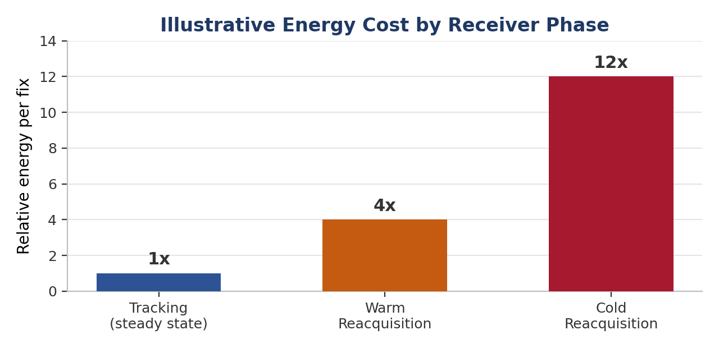
Most GNSS power budgets are built around the receiver’s steady-state tracking current — the datasheet number for “continuous tracking mode.” In the field, that number tells only part of the story. Every time a receiver loses lock and has to find its way back to a fix, it burns far more energy than it does while quietly tracking satellites it already knows about. For battery-powered trackers, wearables, and IoT nodes, this reacquisition penalty is often the single biggest, most overlooked drain on system lifetime.
Acquisition, Tracking, and Reacquisition
Acquisition — the initial search phase. The receiver sweeps a two-dimensional space of frequency (Doppler) bins against code-phase bins for every satellite in view. Computationally heavy: many correlators, or many sequential search bins.
Tracking — the steady state. A narrow loop follows small changes in Doppler and code phase, using a fraction of the correlator resources and power that acquisition needs.
Reacquisition — acquisition’s less forgiving cousin, triggered mid-mission by a signal outage. It’s the phase that quietly dominates power budgets in real deployments.
I
Why Reacquisition Happens So Often
Urban canyons and foliage repeatedly block and unblock line of sight as a device moves.
Tunnels and building interiors cause complete signal loss for seconds to hours.
Multipath / interference can drop carrier-to-noise ratio below the tracking threshold even with a nominally visible satellite.
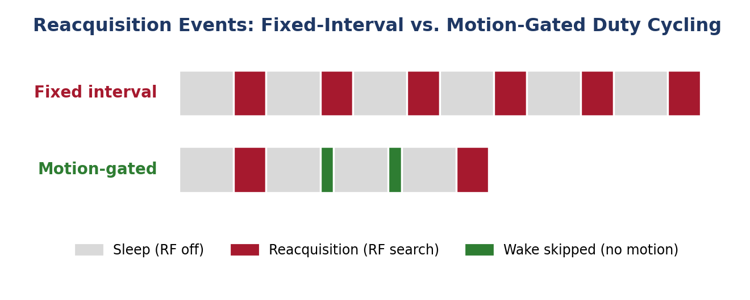
Aggressive duty-cycling is itself a major cause: powering down the RF front end between fixes means every wake-up is, by definition, a reacquisition — not a continuation of tracking. This creates a direct tension: more aggressive duty-cycling means paying the larger reacquisition cost more often instead of the smaller tracking cost.
Where the Power Actually Goes
Wider search space — no recent time/ephemeris estimate forces a full Doppler/code-phase sweep, orders of magnitude more correlator work than a warm reacquisition.
Longer time-to-fix (TTFF) — more search bins and weaker signal both stretch active RF/baseband time, and therefore energy, per fix.
Repeated partial searches — marginal conditions can cause several failed acquisition attempts before a stable fix, multiplying the energy cost.
Ephemeris/almanac staleness — valid for ~2–4 hours; a longer sleep forces a full re-download (~18–30+ seconds) in a high-power state.
Duty-Cycling Smarter, Not Just Less
The tracking-vs-reacquisition trade-off is not a hard trade-off- it’s a design decision. A few techniques keep most of the standby savings while shrinking the reacquisition penalty per wake-up:
Adaptive/variable intervals : shorten sleep when moving quickly (favouring cheap hot starts), lengthen it when stationary or predictable.
Keeping time, not signal — a disciplined RTC/TCXO through sleep preserves time accuracy, narrowing the Doppler search on wake-up for very little standby current.
Coarse signal-presence checks — a low-power pre-check before a full search avoids to do attempts when the antenna does not have a good sky view.
Batching around known outages — scheduling wake-ups to avoid predictable blockage (a daily tunnel, an overnight indoor period).
Hybrid tracking modes — an intermediate low-power lock state turns “reacquisition” into a cheap return to precision rather than a search from scratch.
Other Levers Worth Engineering For
A-GNSS assistance data and extended/predicted ephemeris collapse the search space and avoid the re-download tax after long sleeps.
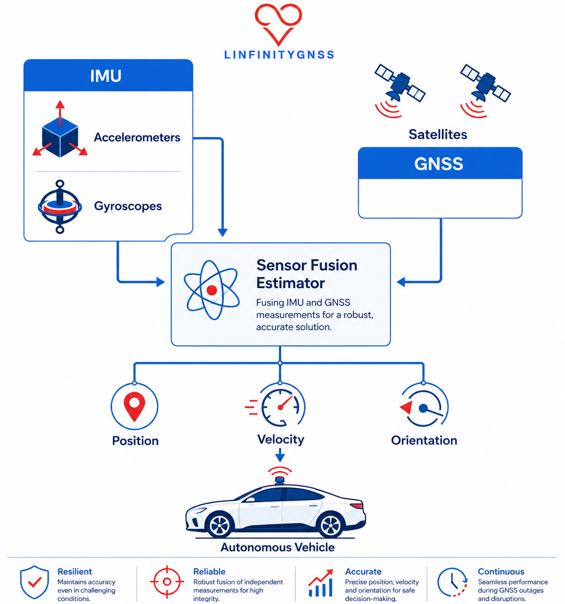
Sensor fusion / dead reckoning bridges short outages and narrows the search space on wake-up.
Multi-constellation, multi-frequency receivers and better antenna/RF quality reduce how often lock is lost in the first place — the cheapest fix of all.
The Takeaway
Datasheet tracking current says little about real-world battery life. Reacquisition frequency and cost are usually the real determinant. Power budgets for trackers, wearables, and IoT devices should be built around a realistic reacquisition rate for the target environment – and clever duty-cycling, assistance data, and sensor fusion should be treated as core power-management features, not optional ext
The Hidden Power Cost of GNSS Reacquisition infinitygnss.com Most GNSS power budgets are built around the receiver’s steady-state tracking current — the datasheet number for “continuous tracking mode.” In the field, that number tells only part of the story. Every time a receiver loses lock and has to find its way back to a fix,…
GNSS receivers are designed to recover extremely weak signals from satellites millions of kilometres away. That makes them inherently vulnerable to radio-frequency interference: a nearby interferer does not need to reproduce a GNSS signal to cause damage. It only needs to raise the interference environment at the receiver input enough to reduce tracking margin, desensitize the front end, or prevent acquisition and tracking altogether.
The engineering response is not simply to buy an “anti-jam antenna”. Resilient PNT is a system property. Antenna architecture, RF filtering, receiver dynamic range, interference detection, adaptive processing, firmware, installation, and—where required—independent sensors and holdover all contribute to the outcome.
This guide explains the differences between a conventional fixed-reception-pattern antenna (FRPA), pattern-shaped antennas, and controlled-reception-pattern antennas (CRPAs); explains why CRPA performance depends on the antenna electronics and receiver architecture; and provides a practical framework for selecting the appropriate level of protection.
1. Standard Antennas vs. Anti-Jamming Antennas: What Actually Changes?
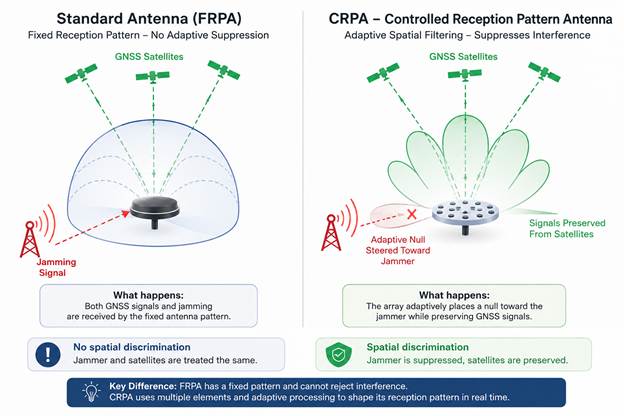
A conventional GNSS antenna has a fixed spatial reception pattern. It may be a simple patch, a more sophisticated precision antenna, or a multi-band design with filtering and a low-noise amplifier. Its pattern is determined by the antenna geometry, ground plane, radome, installation, and RF design. Once manufactured and installed, that pattern does not adapt in real time to the direction of an interferer.
That distinction matters because the antenna does not intrinsically know whether an RF signal is legitimate or hostile. A jammer arriving from an azimuth and elevation inside the antenna’s useful reception region is simply another RF input. If the interference is strong enough, the receiver may lose carrier tracking, suffer front-end compression or saturation, or experience a rise in the effective noise floor.
A CRPA takes a fundamentally different approach. Instead of relying on a single antenna element, it uses multiple spatially separated elements whose signals are processed coherently. The system can estimate the spatial characteristics of interference and apply complex weights to the element signals. The resulting array response can place deep spatial nulls toward one or more interferers while retaining useful sensitivity to GNSS signals.
The important point is that a CRPA does not simply ‘block the jammer’. It changes the spatial weighting of the received signals before the receiver processes them as GNSS measurements. The exact architecture varies between products: some systems emphasize null steering, some combine nulling and beamforming, and some integrate additional interference detection or filtering.
Figure 1 — Fixed reception versus adaptive spatial filtering. The CRPA concept is shown as an adaptive spatial response with a null directed toward the interferer.
One terminology point is worth making: an FRPA should not be described as having ‘equal gain in every direction’. Real GNSS antennas have elevation and azimuth-dependent gain, polarization characteristics, multipath sensitivity, and often deliberate pattern shaping. The defining property of an FRPA is that its spatial response is fixed—not that it is perfectly isotropic.
2. There Is a Middle Ground: Pattern-Shaped Antennas
Between a conventional antenna and a full CRPA there are antennas designed to reduce interference through a fixed spatial pattern. Choke rings, optimized ground planes, low-elevation suppression, and out-of-band filtering can all reduce the amount of unwanted energy reaching the receiver.
This works well when the interference geometry is predictable. For example, suppressing low-elevation signals can reduce the impact of a ground-based jammer while preserving most of the useful GNSS sky view.
But the pattern is fixed. If the jammer moves, the antenna cannot move the rejection zone with it. Pattern shaping reduces vulnerability by design; a CRPA adapts to the interference in real time.
Architecture
Spatial response
Interference discrimination
Typical complexity
FRPA
Fixed
None beyond the inherent antenna pattern
Low
Pattern-shaped antenna
Fixed, deliberately shaped
Limited and geometry-dependent
Low–moderate
CRPA
Adaptive
Dynamic nulling and/or beamforming
Moderate–high
3. Why the Antenna Is Only Part of the Anti-Jam System
The term anti-jam antenna can be misleading. With a conventional GNSS antenna, the antenna is primarily the RF interface between the sky and the receiver. In a CRPA system, the antenna array is only one part of a larger signal-processing chain.
Each array element provides a separate RF signal. These signals must then be calibrated, combined, and weighted to create the desired spatial response. The quality of this processing ultimately determines how much of the array’s theoretical interference-rejection capability can be achieved in practice.
This also makes system compatibility critical. Depending on the architecture, multiple RF paths may connect the array to a separate antenna-electronics unit, or the CRPA may integrate the processing and provide a conventional RF output to the host receiver. Understanding where the adaptive processing takes place—and what the host receiver actually receives is essential.
For example, Antcom specifies compatible antenna electronics for its CRPA arrays, while NovAtel’s GAJT family supports architectures where the CRPA and null-forming electronics can be integrated or separated. These represent different system architectures and should not be treated as interchangeable.
4. The Receiver Still Matters
A CRPA can protect the RF input, but it does not make the receiver immune to interference. Receiver architecture remains critical because strong adjacent-band or in-band signals can challenge the RF front end, filters, amplifiers, mixers, ADCs, automatic-gain-control loops, and tracking algorithms.
Modern GNSS receivers can add significant resilience through wide dynamic range, RF filtering, interference detection, adaptive or notch filtering, spectral monitoring, robust signal processing, and firmware-level mitigation. These techniques do not replace a CRPA in every threat environment, but they can make a substantial difference where the interference level is moderate or the platform cannot tolerate CRPA size, weight, power, and cost.
This leads to a better engineering question than ‘Which anti-jam antenna should I buy?’: ‘What level of interference protection does the complete GNSS architecture need, and where should that protection be implemented?’
5. Jamming, Interference and Spoofing Are Not the Same Problem
The terms interference, jamming, and spoofing are often used interchangeably, but they represent different engineering problems. Jamming is primarily an availability problem; spoofing is an integrity and trust problem.
Threat
What it does
Typical objective
Primary mitigation
Unintentional interference
Adds unwanted RF signal or raises the noise floor
Degrade GNSS performance
Filtering, dynamic range, interference monitoring
Jamming
Deliberately overwhelms GNSS signals
Deny or degrade availability
Spatial nulling, filtering, robust processing
Spoofing
Transmits counterfeit GNSS-like signals
Mislead the PNT solution
Authentication, consistency checks, sensor fusion
A CRPA is primarily an interference-mitigation technology, not an authentication mechanism. It can improve resilience against some jamming and spoofing scenarios through spatial discrimination, but it does not guarantee that interference will be rejected.
Its effectiveness depends on array geometry, calibration, interference direction, signal environment, and adaptive processing. In some conditions, a CRPA can produce an imperfect null, suppress desired GNSS signals, or even increase the effective gain toward an interferer.
A CRPA provides spatial degrees of freedom; it does not guarantee spatial protection. And while it can reject a signal based on where it comes from, it cannot determine by direction alone whether that signal is authentic.
6. How Many Jammers Can a CRPA Suppress?
This is one of the most misunderstood specifications on an anti-jam datasheet.
A common rule of thumb is that an N-element array provides N−1 spatial degrees of freedom for interference suppression when one constraint is reserved for maintaining the desired GNSS response. This is a useful concept, but it does not mean N−1 jammers can always be perfectly rejected.
For example, a four-element array should not automatically be interpreted as being capable of suppressing three jammers under all conditions. Practical performance depends on array geometry, calibration, frequency, jammer separation, bandwidth, algorithm, dynamic range, and GNSS signal preservation. Closely spaced or broadband interferers, strong near-field sources, calibration errors, and platform scattering can significantly reduce effective suppression.
When evaluating a vendor specification, always ask for the test conditions: frequency and bandwidth, interference waveform and power, number and angular separation of interferers, static or dynamic scenario, and whether the result is measured as null depth at the array output or end-to-end GNSS/PNT performance.
7. Matching Protection to the Application
There is no universal ‘best’ anti-jam antenna. Protection should be sized against three things: the threat, the consequence of losing trustworthy PNT, and the platform’s size/weight/power/cost constraints.
Application
Typical exposure
Practical architecture
Main constraint
Consumer IoT / asset tracking
Low to moderate; mainly unintentional interference
The right choice should be driven by the level of threat and the consequences of losing GNSS. A high-end CRPA can be unnecessary overengineering for a low-value tracker, while a basic FRPA may leave a safety- or mission-critical platform dangerously exposed to deliberate, high-power interference. The antenna architecture should match the threat—not simply the product price or performance headline.
8. Why Monitoring Still Matters When You Have a CRPA
Protection without visibility is incomplete. A GNSS receiver can be significantly degraded before it reports a complete loss of position, and it may continue producing a plausible PVT solution while measurement quality is deteriorating. Useful indicators include:
AGC or RF-level indicators — reveal changes in the interference environment and unexpected increases in received power.
C/N₀ trends — expose loss of signal margin and abnormal degradation across satellites.
Spectrum and interference monitoring — helps distinguish narrowband, broadband, swept, and other RF disturbances.
Jamming/interference flags — provide a simple, machine-readable indication for system-level decision logic.
Integrity and consistency monitoring — essential for detecting conditions where the solution remains available but may no longer be trustworthy, particularly under spoofing.
But detection alone is not enough. Every alarm should trigger a defined response. Depending on the application, the system may switch navigation modes, increase reliance on inertial sensors, reject suspect measurements, change its timing source, alert the operator, or transition to a controlled degraded mode.
A resilient GNSS system does not just detect that something is wrong—it knows what to do next.
9. Testing: Do Not Buy the Number on the Datasheet
Anti-jam performance is highly scenario-dependent. A single quoted ‘dB of suppression’ or ‘number of jammers’ is not enough to compare two systems.
A meaningful evaluation should define the GNSS bands under test, interference waveforms, jammer power, jammer-to-signal ratio, angular geometry, number of simultaneous interferers, polarization, platform dynamics, and success criteria.
Laboratory testing can be conducted through conducted RF paths or over-the-air testing. Conducted testing is useful for receiver and signal-processing development, while radiated/OTA testing is necessary when the antenna array, spatial response, installation, and coupling between elements are part of the performance claim. Keysight’s current CRPA testing guidance also emphasizes the need to reproduce realistic NAVWAR conditions rather than relying on a single simplistic interferer.
For a serious procurement, ask for test evidence—not just marketing terminology. The most useful result is a system-level demonstration showing that the receiver continues to acquire and track authentic GNSS signals and maintains acceptable PNT performance under defined interference conditions.
10. Vendor Landscape: Understand What You Are Actually Buying
The market is easiest to understand when divided into two broad groups: vendors providing CRPA/anti-jam antenna systems, and receiver or chipset vendors implementing interference mitigation inside the GNSS receiver. Some companies operate in both spaces.
Antenna and CRPA system providers EXAMPLES
Vendor / family
Positioning in the market
What to look at
Antcom CRPAs
Dedicated CRPA arrays for assured PNT
Element count, frequency coverage, antenna-electronics compatibility, SWaP
Hexagon | NovAtel GAJT
Integrated and federated anti-jam systems across land, marine and airborne platforms
Nulling capability, protected bands, form factor, receiver compatibility, direction finding
Calian / Tallysman
GNSS antennas, pattern shaping and CRPA solutions
Filtering, low-SWaP options, element architecture and integration
Receiver and chipset-level resilience EXAMPLES
Vendor / technology
Approach
Best understood as
Septentrio AIM+
Hardware filtering and receiver-side interference monitoring/mitigation
Receiver-level resilience and visibility
u-blox
Receiver architecture and signal-processing techniques for interference resilience across product families
Low-SWaP receiver-side mitigation; capability varies by device
Unicore NebulasIV / JamShield
Integrated multi-frequency anti-jamming and spoofing detection in selected high-precision modules
SoC/module-level resilience
Quectel
GNSS jamming detection features in selected modules; product capabilities vary
Monitoring and module-level detection rather than a universal CRPA replacement
The important comparison is not simply vendor versus vendor. It is architecture versus architecture. A CRPA system with strong spatial suppression can be the right answer for a contested environment; a receiver with strong interference mitigation may be the better answer for a mass-market product; and a high-quality antenna plus filtering and monitoring may be sufficient for a timing installation whose dominant threat is adjacent-band interference.
11. Questions to Ask Before Selecting an Anti-Jam Solution
What is the actual threat: adjacent-band interference, unintentional RF, consumer jamming, deliberate narrowband jamming, broadband jamming, spoofing, or a combination?
What is the consequence of losing GNSS availability—or worse, accepting an incorrect PNT solution?
Which GNSS constellations and frequencies must remain usable during the interference event?
How many simultaneous interferers must the system handle, and under what geometry?
Is the CRPA supplied as an antenna array only, or does it include antenna electronics and null-forming processing?
Is the output compatible with the intended receiver, and what calibration/configuration is required?
What are the actual SWaP and thermal requirements?
How is performance specified: suppression in dB, maximum J/S, tracking threshold, PVT continuity, or another metric?
Were the claims validated with realistic waveforms and multiple interferers, or only with a laboratory CW signal?
What RF-health and integrity indicators are available to the host system?
What happens when interference is detected—alarm only, mitigation, navigation-mode change, or automatic sensor fallback?
What independent PNT sources are available if GNSS becomes unavailable or untrustworthy?
12. Common Anti-Jam Deployment Mistakes
“We installed a CRPA, but the performance did not improve.”
Check the complete signal chain: array, antenna electronics, receiver compatibility, calibration, cabling, firmware, and installation. A CRPA is a system, not simply a different antenna connector.
“The datasheet says three jammers, so we are protected against three jammers.”
Ask for the exact test conditions. Spatial separation, waveform, bandwidth, frequency, power, polarization, and platform effects can materially change performance.
“Our receiver still has a position, so GNSS is fine.”
A valid PVT output does not prove that the measurements are trustworthy. Monitor RF conditions, signal quality, integrity and cross-sensor consistency.
“Anti-jam means anti-spoof.”
It does not. Spatial filtering can help in some spoofing geometries, but authentication and integrity require additional techniques.
“More nulls must always mean a better product.”
Not necessarily. More elements can increase spatial degrees of freedom, but they also affect size, power, calibration complexity, cost, and integration.
“We chose the highest-performance solution.”
The best solution is the one that meets the threat and mission requirement with an appropriate margin—not necessarily the one with the largest array.
13. Frequently Asked Questions
Is a CRPA always better than an FRPA?
No. A CRPA provides a much more powerful spatial interference-mitigation mechanism, but it adds cost, size, power, complexity and integration requirements. For many low- or moderate-threat applications, a high-quality FRPA combined with a resilient receiver and good monitoring is the better engineering solution.
Can a CRPA stop spoofing?
Not by itself. A CRPA can provide spatial discrimination and may reject a spoofer when the spatial geometry is favorable, but spoofing is fundamentally an integrity problem as well as an RF problem. Authentication, signal consistency checks and independent sensors may be required.
How many simultaneous jammers can a CRPA suppress?
A useful first-order concept is approximately one fewer independent null than the number of antenna elements, but practical capability is product- and scenario-dependent. Treat the vendor’s tested performance—not the rule of thumb—as the specification.
Do I need a CRPA if my receiver already has interference mitigation?
Not necessarily. Receiver-side mitigation can be extremely effective against many interference scenarios. A CRPA becomes increasingly valuable when interference is strong, spatially localized, deliberate, multi-source, or capable of overwhelming the receiver front end.
What is the biggest procurement mistake?
Treating the antenna as an isolated component. The correct unit of analysis is the complete PNT chain: antenna, RF front end, receiver, mitigation algorithms, monitoring, installation and fallback sensors.
14. The Takeaway
There is no such thing as a universally ‘best’ anti-jamming antenna. There is only a protection architecture that is appropriate—or inappropriate—for a particular threat and mission.
A conventional FRPA provides a fixed spatial response. Pattern-shaped antennas can reduce susceptibility to interference from particular directions. A CRPA goes further by using multiple antenna elements and adaptive processing to reshape the spatial response in real time, creating nulls toward interference while preserving useful GNSS signals.
But spatial filtering is only one layer. Receiver dynamic range, filtering, interference detection, signal processing, integrity monitoring, inertial sensors, alternative timing sources and operational procedures determine whether a platform actually remains resilient when GNSS is under attack.
The right question is therefore not: ‘Which anti-jam antenna should we buy?’
The right question is: ‘What level of PNT resilience does this application require, what threats must it withstand, and where should that resilience be implemented?’
Sources and Further Reading
Keysight — CRPA Antennas Explained: Choosing and Testing the Best Anti-Jam Solutions for GPS/GNSS Resilience.
Keysight — How to Conduct CRPA Anti-Jam Antenna Testing.
Antcom — CRPAs for Assured Positioning, Navigation and Timing (APNT).
Hexagon | NovAtel — GNSS Anti-jam Antenna Systems (GAJT) and GAJT product documentation.
Calian — Resilient GNSS and Anti-Jamming Solutions; CR7712EXF documentation.
Septentrio — Advanced Interference Monitoring and Mitigation (AIM+).
Quectel — GNSS Jamming Detection Application Note for BG95/BG77/BG600L series.
Editorial note: Product capabilities change over time and vary by model, firmware and configuration. Vendor-specific statements in this guide should therefore be checked against the current product documentation before being used as procurement specifications.
GNSS receivers are designed to recover extremely weak signals from satellites millions of kilometres away. That makes them inherently vulnerable to radio-frequency interference: a nearby interferer does not need to reproduce a GNSS signal to cause damage. It only needs to raise the interference environment at the receiver input enough to reduce tracking margin, desensitize…
A standalone GNSS receiver can typically determine its position to within a few meters under open-sky conditions.
For everyday navigation, this is sufficient: A vehicle following a road, a pedestrian using a map application, or a fitness tracker measuring distance does not require centimeter-level accuracy.
However, a wide range of professional applications operate at a completely different level of precision. In surveying, precision agriculture, construction, and machine control, a few meters of error is not a minor inconvenience — it can mean a boundary marker placed incorrectly, a grading pass that misses its target elevation, or planting rows that overlap instead of aligning cleanly.
So how does GNSS move from meter-level positioning to centimeter-level accuracy?
The answer, for most high-precision deployments, is RTK — Real-Time Kinematic positioning.
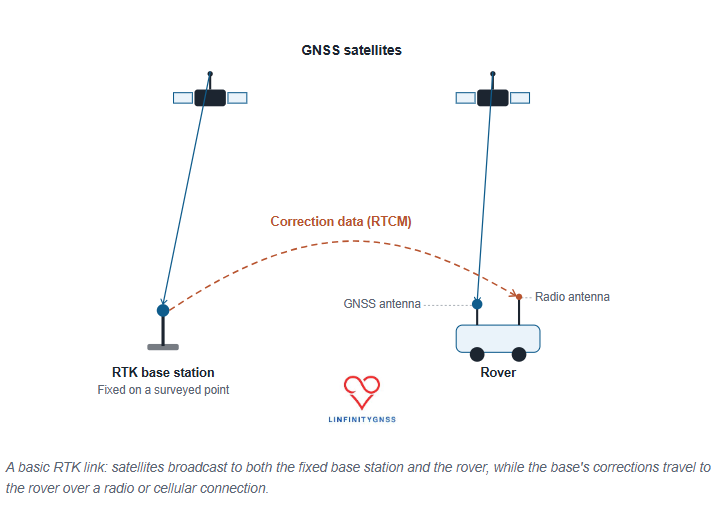
RTK relies on a simple but powerful principle: a second GNSS receiver, installed at a precisely known location, measures many of the same errors affecting the mobile receiver and helps remove them in real time.
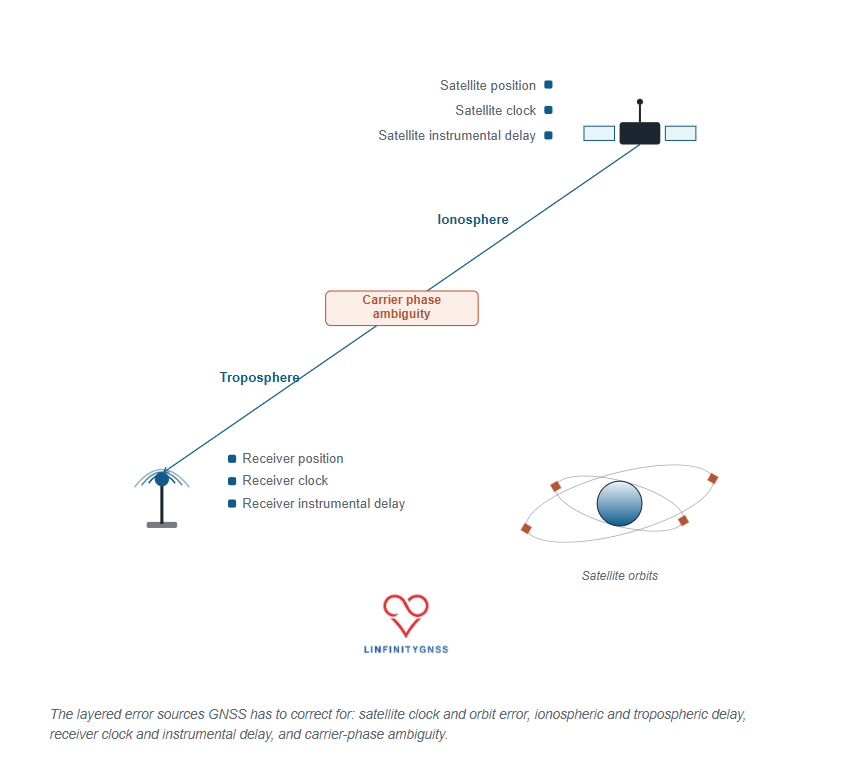
Where GNSS errors come from
Every GNSS position is calculated from measurements between satellites and the receiver. Those measurements, however, are affected by several distinct error sources:
Satellite clock errors — satellites carry extremely precise clocks, but even a tiny timing error translates directly into a distance error.
Satellite orbit errors — the broadcast position of a satellite is never perfectly accurate.
Ionospheric delay — charged particles in the upper atmosphere slow and distort GNSS signals.
Tropospheric delay — temperature, pressure, and humidity in the lower atmosphere affect signal propagation.
Receiver clock errors — the receiver’s clock is far less precise than the atomic clocks carried onboard satellites.
Carrier-phase ambiguity — although carrier-phase measurements are extremely precise, the receiver initially does not know the exact number of complete carrier cycles between itself and the satellite.
The challenge is that standalone GNSS positioning has no way to separate and remove these errors on its own. RTK solves this by introducing a second receiver.
The RTK principle: two receivers observing the same errors
A fixed-base RTK system consists of three components:
A base station installed on a precisely known point.
A rover receiver whose position needs to be determined.
A communication link carrying correction data from the base to the rover.
The key advantage of this system is that the base station already knows exactly where it is — and the rover uses this information by combining its own observations with the base’s through a two-stage process called differencing.
Single Differencing: Eliminating Satellite Errors
The first stage compares observations from the base station and the rover tracking the same satellite at the exact same time.
What it eliminates: Satellite clock errors and satellite instrumental delay. Because these errors originate at the source of transmission, they appear identically in both receivers and cancel out completely when subtracted.
What it reduces: Satellite orbit errors and atmospheric delays (ionospheric and tropospheric). These are heavily mitigated because both receivers look through a similar path in space, though the cancellation becomes less effective as the distance (baseline) between receivers increases.
Double Differencing: Eliminating Receiver Errors
The second stage is called double differencing where the rover’s processing engine selects one satellite as a “pivot” or reference satellite (usually the one highest in the sky with the cleanest signal).It then pairs that reference satellite with every other visible satellite individually.
Receiver clock bias and receiver instrumental delay. Because these errors are due to the receiver’s internal hardware, they affect all satellite observations equally at that moment in time. Comparing two different satellites removes the hardware bias entirely.
What Remains to Be Solved
After this two-stage process, the remaining signal contains only three elements:
The true geometric range difference between the two receivers and the satellites.
A small, residual atmospheric error that grows with baseline length (limiting most RTK setups to a 20 km radius).
The carrier-phase ambiguity, which is the unknown number of full signal wavelengths between the antennas and satellites. Resolving this final integer value is what locks in centimeter-level accuracy.
The effect of differencing can be summarized as follows:
Error Source
Effect of RTK Differencing
Satellite clock error
“Nearly” eliminated
Satellite hardware bias
Eliminated
Receiver clock error
Eliminated
Receiver hardware bias
Eliminated
Orbit error
Strongly reduced
Atmospheric delay
Reduced
Carrier-phase ambiguity
To be resolved
The fixed base station: the foundation of RTK accuracy
A fixed base station is a GNSS receiver installed on a stable point with accurately known coordinates. That coordinate can be obtained one of two ways.
Fixed coordinate mode
The true position of the antenna is already known, from a previous survey or reference measurement, and entered directly into the receiver — usually in Earth-Centered Earth-Fixed (ECEF) coordinates. This is the preferred approach for permanent reference stations.
Survey-in mode
The receiver determines its own position by averaging many GNSS observations over time. A short survey-in period may be sufficient for temporary setups and quick debugging, while a high-quality permanent reference station typically requires a much longer averaging period — often around 12 hours — to arrive at a stable coordinate.
Once the base coordinate is fixed, the receiver continuously compares where it knows it is against where its raw GNSS measurements suggest it is. That difference becomes the correction information sent to the rover.
Why the base antenna matters
The quality of the antenna places a practical ceiling on RTK performance. A “good” reference antenna should provide the following.
Stable installation
The antenna must not move after the coordinate has been calculated. Even a small physical shift introduces error, because the reference point is no longer where the receiver believes it is.
Excellent sky visibility
Obstructions, reflections, and multipath can contaminate measurements. An unobstructed view of the sky in every direction is essential.
Multi-constellation and multi-frequency support
Modern systems commonly track GPS, Galileo, GLONASS, BeiDou, QZSS, and SBAS across multiple frequency bands, which improves robustness and speeds up ambiguity resolution.
Good signal quality
Important antenna characteristics include right-hand circular polarization (RHCP), “suitable gain”, low-noise amplification, and resistance to interference.
The installation environment is also a very important factor — keep it clear of nearby processors, cabling, and other transmitters.
How corrections reach the rover: RTCM and NTRIP
The base station doesn’t transmit a corrected position — it sends measurement information that allows the rover to calculate its own corrected position. The industry-standard format for this information is RTCM (Radio Technical Commission for Maritime Services).
RTCM messages carry:
Pseudorange observations
Carrier-phase measurements
Signal quality indicators
Satellite information
Antenna reference coordinates
Ephemeris information
Modern RTK systems commonly use RTCM 3.x messages, including MSM (Multiple Signal Messages), which support multi-constellation and multi-frequency observations.
A critical practical point: the rover and base must speak the same RTCM language. A mismatch in RTCM version, MSM message type, supported constellations, or correction content is one of the most common reasons for a delayed fix or a failure to ever reach RTK FIX status.
NTRIP: delivering corrections over the internet
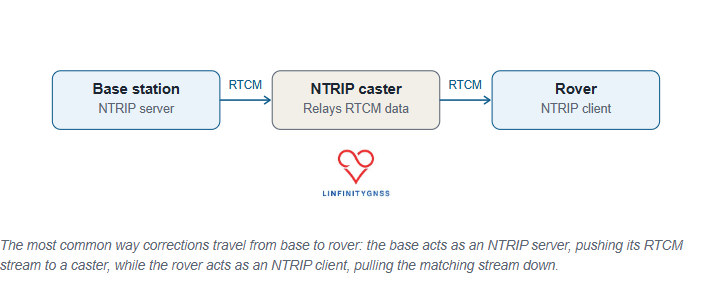
The most common way of distributing RTK corrections today is NTRIP — Networked Transport of RTCM via Internet Protocol. The architecture runs base station → NTRIP server → NTRIP caster → rover.
The base uploads its RTCM correction stream to a caster. The rover connects to that caster as an NTRIP client and requests the appropriate correction stream, usually identified by a mountpoint. This approach allows a single reference station network to support a large number of users without requiring a direct radio connection between base and rover.
The rover: where the final position is calculated
The rover is the moving receiver whose position is actually required. It needs:
A reliable communication link
A suitable GNSS antenna
Compatible correction data
Sufficient satellite visibility
Cellular connectivity, especially LTE, is commonly used for the communication link, since it offers wide coverage and sufficient bandwidth for the correction stream.
The rover continuously evaluates the incoming correction data and attempts to resolve the carrier-phase ambiguities. Its output normally includes a positioning status:
RTK FLOAT — ambiguity resolution hasn’t completed; accuracy is typically at the decimeter level or worse.
When troubleshooting RTK performance, this status is usually the first thing to check.
The baseline limitation: why distance matters
Fixed-base RTK has a fundamental limitation: the distance between base and rover. The farther apart they are, the less similar their error environment becomes. A rover 5 km from the base observes almost the same atmosphere as the base does. A rover 100 km away does not.
As the baseline increases, atmospheric errors become less correlated, ambiguity resolution becomes harder, and accuracy gradually decreases. A common operational guideline keeps the rover within roughly 20 km of the base for reliable traditional RTK.
For larger coverage areas, correction networks use approaches such as a Virtual Reference Station (VRS). Instead of relying on one distant physical base, the network combines several reference stations and synthesizes a virtual reference point close to the rover — reducing atmospheric differences and improving fix reliability.
Common RTK problems and causes
The receiver stays in FLOAT mode
Common causes: incompatible RTCM messages, insufficient satellite visibility, multipath, poor signal quality, or an excessive baseline distance.
No fix despite an apparently correct configuration
Check the antenna installation, nearby interference sources, correction stream availability, and satellite tracking quality. Carrier-to-noise ratio is an important indicator — poor signal quality can prevent reliable ambiguity resolution even when the rest of the setup looks correct.
Fix degrades during movement
Possible causes: cycle slips, high dynamics, interruptions in the correction stream, or a baseline that’s simply too long.
Frequently asked questions
How many satellites are required for RTK?
The exact requirement depends on the receiver and configuration, but a greater number of satellites across multiple constellations improves reliability. Modern multi-constellation receivers commonly track dozens of signals, providing much stronger redundancy than older single-constellation systems.
Do corrections need to be continuous?
For dynamic applications, continuous correction delivery is essential. Static or slow-moving applications may tolerate short interruptions, but performance depends heavily on receiver design and the surrounding environment.
Does more correction data mean higher cost?
Usually, yes. Higher-density RTCM messages provide more information but require more bandwidth. Reducing the message rate saves data but may reduce robustness, especially for a moving receiver.
The takeaway
Fixed-base RTK remains the foundation of centimeter-level GNSS positioning. The concept itself is simple: a receiver sits on a precisely known point, measures the errors affecting GNSS signals, and sends correction data to another receiver. The rover uses those corrections to resolve carrier-phase ambiguities and determine its position with centimeter-level accuracy.
The technology is mature, but reliable performance depends on getting the details right — antenna quality, reference coordinate accuracy, RTCM compatibility, communication reliability, and baseline distance.
RTK isn’t simply about receiving corrections. It’s about establishing a trustworthy relationship between two receivers — one fixed, one moving — and using that relationship to turn imperfect satellite measurements into precise, dependable positioning.
A standalone GNSS receiver can typically determine its position to within a few meters under open-sky conditions. For everyday navigation, this is sufficient: A vehicle following a road, a pedestrian using a map application, or a fitness tracker measuring distance does not require centimeter-level accuracy. However, a wide range of professional applications operate at a…
GNSS jamming and spoofing pose critical risks to positioning systems. Learn why multi-constellation receivers are not enough and what true GNSS integrity and resilience require.
Modern GNSS receivers are highly capable systems. They acquire signals from multiple constellations, track satellites across multiple frequencies, and deliver a position solution with high apparent confidence.
The challenge is that this confidence can be misleading.
A receiver may report a valid position, stable tracking, and strong signal conditions—while the output itself is incorrect.
In many cases, there are:
No alarms
No explicit warnings
No loss of signal
Just a plausible navigation solution derived from corrupted or deceptive inputs.
This is the core issue behind GNSS spoofing and jamming resilience: failure is not always visible.
For organisations relying on positioning, navigation, and timing (PNT), the consequences extend beyond positioning errors into operational, safety, and timing-critical failures.
GNSS Jamming vs Spoofing: Two Fundamentally Different Threats
GNSS interference is often treated as a single problem. In reality, jamming and spoofing represent fundamentally different failure modes requiring different responses.
GNSS Jamming (Signal Denial)
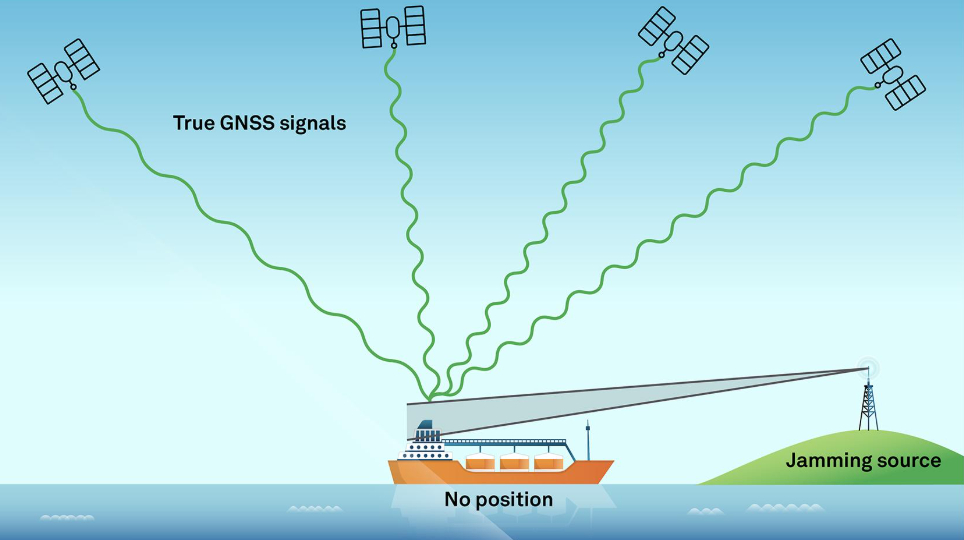
GNSS jamming occurs when radio-frequency interference raises the noise floor, preventing receivers from tracking satellite signals.
Because GNSS signals are extremely weak, even low-power interference can disrupt reception.
Typical effects of jamming:
Loss of satellite lock
Reduced carrier-to-noise ratio (C/N₀)
Position solution degradation or complete loss
Switch to fallback navigation (if available)
Jamming is usually:
Sudden
Detectable
Associated with signal degradation
Jamming tells you something is wrong.
GNSS Spoofing
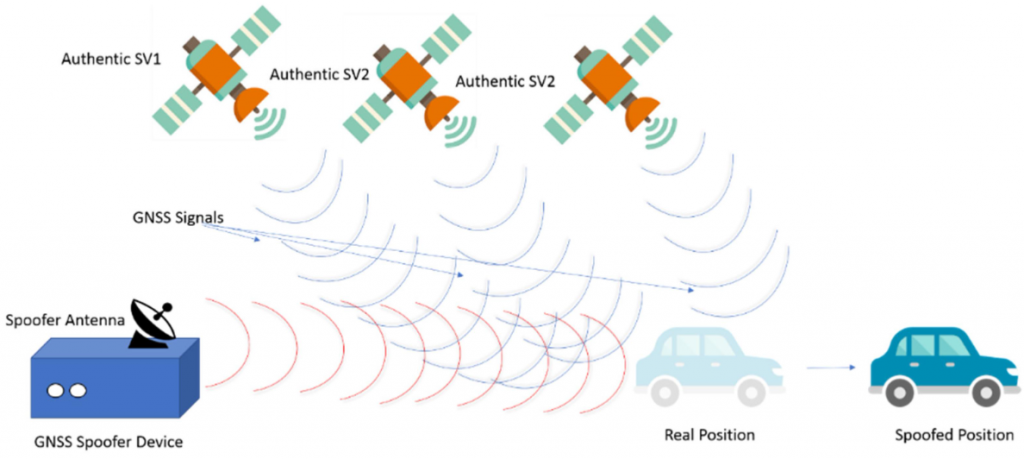
Spoofing replaces authentic GNSS signals with counterfeit ones that mimic real satellites.
The receiver continues operating normally.
Typical effects of spoofing:
Continuous tracking of satellites
Stable signal metrics
Valid-looking navigation solution
No obvious alarms
Spoofing tells you everything is fine—while the output is wrong.
This makes spoofing particularly dangerous for autonomous and safety-critical systems.
Why Multi-Constellation GNSS Is Not Enough
Using multiple GNSS constellations—GPS, Galileo, GLONASS, and BeiDou—can improve availability and provide some resilience against jamming, as interference may not affect all signals equally.
However, multi-constellation capability does not eliminate the risk of spoofing.
A sophisticated attacker can generate counterfeit signals across multiple constellations simultaneously, while maintaining realistic satellite geometry, orbital behaviour, and timing consistency. To the receiver, everything appears normal.
As a result:
The receiver observes what appears to be a healthy satellite sky.
Signal quality metrics remain within expected limits.
The navigation solution is calculated with high confidence.
There is no obvious indication that the position is being manipulated.
Multi-frequency and multi-constellation processing can help detect poorly executed or inconsistent spoofing attempts. However, well-designed attacks can remain undetected unless additional integrity monitoring and signal authentication mechanisms are in place.
The key lesson is simple: more satellites do not automatically mean more trust. True GNSS resilience requires independent validation of the navigation solution, not just additional signals.
Conclusion: Multi-constellation capability is necessary, but not sufficient for GNSS resilience.
GNSS Integrity Monitoring: The Real Challenge
GNSS integrity is the ability to assess whether a navigation solution is reliable and trustworthy.
The fundamental challenge is not whether a position is available—it is whether that position is correct.
Most GNSS systems are designed to optimise for:
Continuous signal tracking
Consistent navigation output
Maximum position availability
However, they are often not designed to:
Detect deliberate deception
Identify and classify interference events
Recognise when a seemingly valid position is actually wrong
Reject plausible but manipulated navigation solutions
This creates what is known as the integrity gap.
A jammed receiver often loses signals and raises alarms. A spoofed receiver, by contrast, may continue operating normally while reporting a false position with complete confidence. Even partial degradation can remain undetected if it does not exceed predefined alert thresholds.
In other words, the most dangerous GNSS failures are not always the ones that stop navigation—they are the ones that quietly provide the wrong answer.
Five Layers of GNSS Resilience
True resilience requires layered architecture—not a single feature.
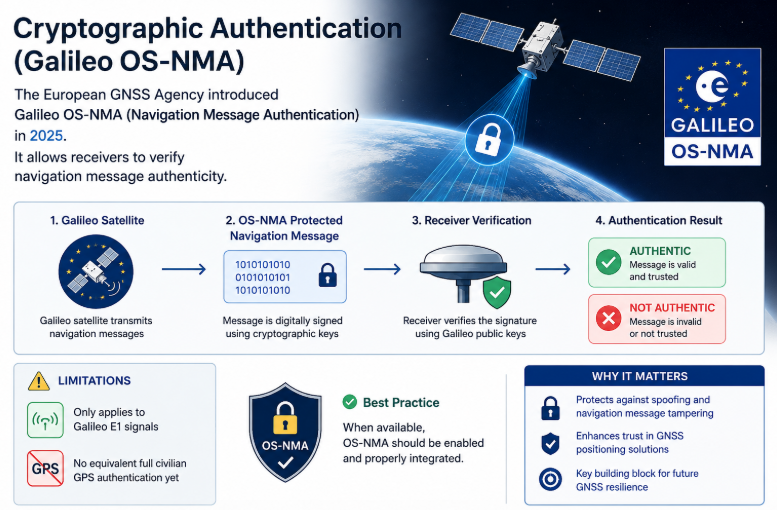
1. Cryptographic Authentication (Galileo OS-NMA)
The European GNSS Agency introduced Galileo OS-NMA (Navigation Message Authentication) in 2025.
It allows receivers to verify navigation message authenticity.
Limitations:
Only applies to Galileo E1 signals
No equivalent full civilian GPS authentication yet
When available, OS-NMA should be enabled and properly integrated.
2. Inertial Fusion (IMU Integration)
GNSS can be manipulated. Physics cannot.
IMUs provide independent motion data.
Benefits:
Detect GNSS vs motion inconsistencies
Identify spoofing-induced drift
Provide continuity during outages
Architectures:
Loosely coupled → basic detection
Tightly coupled → high resilience
Deep integration → strongest protection
Tight coupling is recommended for safety-critical systems.
3. Signal-Level Detection
Traditional methods rely on:
C/N₀
AGC
Residual errors
These are increasingly insufficient.
Modern systems use:
Time-series anomaly detection
RF behaviour modelling
Machine learning classification
Key principle: detection is stronger at signal-processing level than after position computation.
4. Independent PNT Sources
No GNSS system is fully resilient on its own.
Alternative PNT sources include:
eLoran (terrestrial navigation and timing)
5G Advanced positioning
Chip-scale atomic clocks (timing holdover)
Principle: Critical systems must never rely on a single PNT source.
5. Human Factors and Operational Awareness
Technology alone does not ensure resilience.
Operators must understand:
Jamming = signal loss or degradation
Spoofing = correct-looking but false data
Required responses:
Jamming → fallback navigation
Spoofing → reject data integrity
Most dangerous failure mode is not GNSS loss—it is trusting incorrect GNSS data.
Five Questions to Ask Your GNSS Vendor
Before selecting a receiver or system:
Does it support Galileo OS-NMA and how is it implemented?
Where does spoofing detection occur (signal or solution level)?
What level of IMU coupling is used?
What independent PNT sources are supported?
How are jamming and spoofing differentiated in alerts?
If answers are unclear, system maturity is likely limited.
The Future of GNSS Resilience
GNSS interference is not a temporary issue—it is an evolving operational reality.
Future resilience will depend on integration of:
Authentication
Sensor fusion
Signal analytics
Multi-source PNT
Operational training
Multi-constellation receivers are a foundation—but not a complete solution.
Conclusion
GNSS jamming and spoofing represent fundamentally different threats.
Jamming is visible and disruptive
Spoofing is silent and deceptive
The real challenge is not maintaining signal reception—it is maintaining trust in the navigation solution.
True GNSS resilience requires system-level architecture, not receiver-level assumptions.
The future of GNSS resilience will not be defined by how many satellites a receiver can track.
It will be defined by how confidently it can determine whether those signals should be trusted.
Because the most dangerous GNSS failure is not losing position.
It is acting on a position that is wrong.
.
GNSS jamming and spoofing pose critical risks to positioning systems. Learn why multi-constellation receivers are not enough and what true GNSS integrity and resilience require. Modern GNSS receivers are highly capable systems. They acquire signals from multiple constellations, track satellites across multiple frequencies, and deliver a position solution with high apparent confidence. The challenge is…
AI in GNSS: Why Cybersecurity Can’t Be an Afterthought
AI is rapidly becoming embedded in GNSS systems — from signal processing and anti-jam/anti-spoof detection through to autonomous positioning corrections. For most teams, the conversation about AI has so far focused on accuracy, data quality, and regulatory compliance.
That’s an incomplete picture.
AI is not just a data problem or a compliance problem. It is a security problem — and for GNSS-dependent navigation, timing, and infrastructure systems, getting this wrong has consequences that go well beyond a failed audit.
Here’s what every GNSS engineering team needs to understand.
1. Cybersecurity Is a Precondition, Not an Add-On
The Guidelines for Secure AI System Development (2023) state it plainly:
“Cybersecurity is a necessary precondition for the safety, resilience, privacy, fairness, efficacy and reliability of AI systems.”
This is easy to read past, but it’s worth sitting with. It doesn’t say cybersecurity is one of several important properties. It says the other properties — safety, fairness, reliability — depend on it. An AI system that isn’t secure cannot meaningfully be called safe or reliable, no matter how good its outputs look in testing.
Why this matters for GNSS A positioning or timing system that performs beautifully on the bench but rests on an insecure AI component isn’t a robust system — it’s a system with an unverified dependency.
2. What “High-Risk” Actually Requires
For systems classified as high-risk — and GNSS-dependent navigation, timing, and critical infrastructure squarely fall into this category — the bar is set across several dimensions simultaneously:
Accuracy — the model performs to the standard the application demands
Robustness — performance holds up under degraded, noisy, or adversarial conditions
Cybersecurity — the model and its data pipeline resist manipulation
Risk management — failure modes are identified and mitigated, not just documented
Data governance — training and operational data is controlled, traceable, and clean
Human oversight — a person remains meaningfully in the loop
Fix None of these can be treated as a separate workstream ticked off independently. A model can be highly accurate and still be insecure; it can be secure and still lack proper oversight. Build your assurance case so these properties are demonstrated together, not in isolation.
3. The Threat Surface Has Moved Inside the Model
This is the shift that catches many teams out.
Historically, securing a GNSS system meant securing the hardware, the RF front end, and the network around it. With AI in the loop, the model itself becomes part of the attack surface.
Consider an AI system trained to detect spoofing or jamming on a GNSS signal. If that model can be subtly poisoned, manipulated, or degraded, it doesn’t just stop working — it can continue to appear to work while quietly failing. A compromised model could mask the very interference it was built to flag, giving operators false confidence at exactly the moment accurate information matters most.
This mirrors a problem GNSS engineers already know well from spoofing: the most dangerous failures are the ones that don’t trigger an alarm.
Fix Treat the AI model with the same scrutiny you’d apply to a GNSS signal chain. Monitor for drift, unexpected confidence patterns, and outputs that don’t align with independent sensor data (e.g. IMU). If your spoofing-detection AI starts behaving “too well,” that’s worth investigating, not celebrating.
4. Build Security In From the Start
Retrofitting security after an AI system is deployed is significantly harder — and significantly riskier — than designing it in from the outset. In practice, this means:
Treating model integrity with the same rigour as data quality and algorithmic fairness — it’s not a lesser concern, it’s part of the same assurance picture
Defining clear acceptance criteria for AI outputs, so that every decision in the loop has a documented threshold for what counts as a valid, trustworthy result — not just “the model said so”
Involving security expertise during system design, not only during late-stage testing
Building incident response plans that account for AI-specific failure modes, including subtle manipulation that may not trigger traditional alerts
Fix Ask, early in your design process: if this model were quietly wrong, how would we know? If you don’t have a confident answer, your acceptance criteria and monitoring strategy need work before deployment — not after.
5. Securing the Intelligence Layer
As GNSS systems become smarter, more adaptive, and more autonomous, security has to evolve with them. Securing the signal is no longer enough — securing the intelligence layer (the models, the data pipelines, the decision logic sitting on top of the signal) is now just as critical.
For organisations operating in this space, the takeaway is simple: bring cybersecurity thinking into AI design early, treat AI security as inseparable from AI safety, and recognise that the next generation of GNSS resilience depends as much on protecting the algorithms as it does on protecting the antennas.
The Bottom Line
AI brings real capability to GNSS — better spoofing detection, smarter signal processing, more autonomous correction. But every one of those capabilities depends on the AI component itself being secure, monitored, and held to clear acceptance criteria.
If you’re integrating AI into a GNSS-dependent system and want a second opinion on your security and assurance approach, we’re happy to take a look.
AI in GNSS: Why Cybersecurity Can’t Be an Afterthought Written by LinfinityGNSS in GNSS Technical Articles AI in GNSS: Why Cybersecurity Can’t Be an Afterthought AI is rapidly becoming embedded in GNSS systems — from signal processing and anti-jam/anti-spoof detection through to autonomous positioning corrections. For most teams, the conversation about AI has so far…
GNSS Correction Services Explained: From RTK to PPP-RTK
Global Navigation Satellite Systems (GNSS), including GPS, Galileo, GLONASS, and BeiDou, underpin a rapidly growing ecosystem of applications ranging from precision agriculture and surveying to autonomous systems, robotics, and connected mobility.
While standalone GNSS positioning enables global navigation with metre-level accuracy, many modern applications require significantly higher performance.
Achieving decimetre- or centimetre-level positioning requires the mitigation of multiple error sources that affect GNSS measurements. This is the role of GNSS correction services.
Understanding the capabilities, limitations, and underlying principles of these services is essential for selecting the most appropriate solution for a given application.
Why Are GNSS Corrections Required?
A standalone GNSS receiver determines its position by estimating the distance, or pseudorange, to multiple satellites. The resulting position solution is affected by several error sources, including:
Satellite clock errors
Satellite orbit errors
Ionospheric and tropospheric delays
Multipath
Receiver noise
Collectively, these errors limit standard positioning performance to approximately 3–10 metres, depending on receiver quality, environmental conditions, and satellite geometry.
GNSS correction services improve positioning performance by estimating and compensating for these errors using measurements from reference stations with precisely known coordinates.
Depending on the correction methodology employed, positioning accuracy can be improved from metre-level to centimetre-level performance.
How Do GNSS Correction Services Work?
A reference station continuously receives signals from GNSS satellites and calculates the errors affecting those signals.
These corrections are then delivered to a user’s GNSS receiver, commonly referred to as a rover. The rover applies the corrections to improve its position estimate.
Corrections can be delivered through various communication channels, including:
NTRIP over internet connections
UHF or VHF radio links
L-band satellite services
Direct satellite broadcasts
It is important to distinguish between the correction method and the delivery method. For example, RTK is a positioning technique, while NTRIP is a protocol used to transmit correction data over the internet.
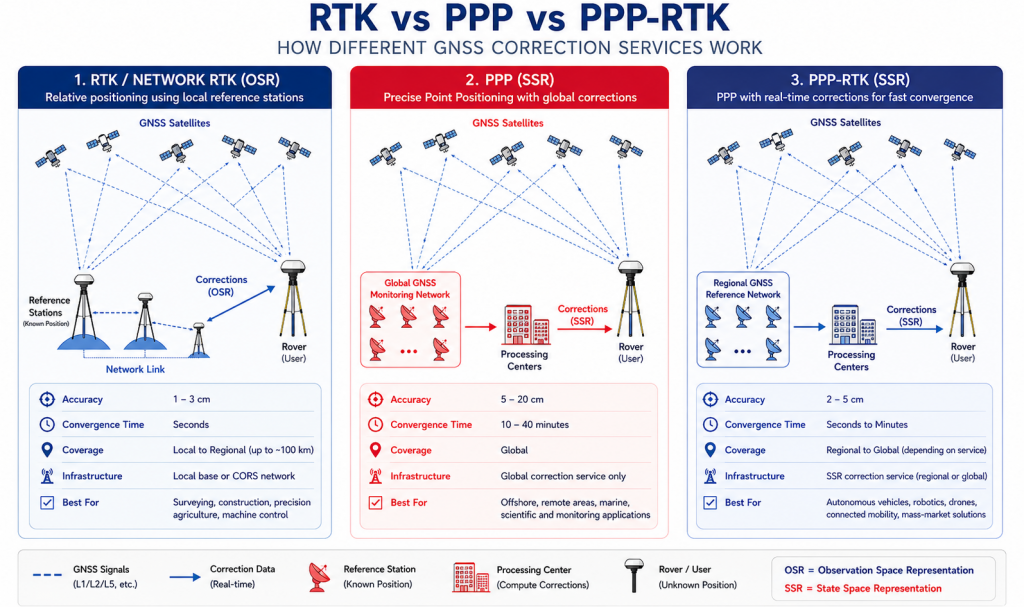
Observation Space Representation (OSR) and State Space Representation (SSR)
GNSS correction services are generally based on one of two approaches.
Observation Space Representation (OSR)
OSR corrections are generated for a specific user location and applied directly to GNSS observations.
Traditional RTK and Network RTK services use OSR corrections.
OSR approaches provide rapid ambiguity resolution and excellent positioning performance but require dense reference station networks and generate user-specific correction streams.
State Space Representation (SSR)
SSR corrections model individual error sources, including:
Satellite orbit errors
Satellite clock errors
Signal biases
Atmospheric delays
SSR corrections are independent of user location, making them more scalable for large numbers of users.
PPP and PPP-RTK services typically use SSR corrections.
Satellite-Based Augmentation Systems (SBAS)
Satellite-Based Augmentation Systems provide wide-area corrections generated from regional reference networks and broadcast through geostationary satellites.
Examples include:
EGNOS in Europe
WAAS in North America
MSAS in Japan
GAGAN in India
SBAS services primarily compensate for satellite orbit, clock, and ionospheric errors, improving standalone positioning accuracy to approximately 0.5–2 metres.
SBAS also provides integrity information, making it particularly valuable for aviation applications.
Differential GNSS (DGNSS)
Differential GNSS uses code-based corrections generated by a nearby reference station.
Because many GNSS errors are spatially correlated, users operating within a limited distance of the reference station can benefit from significant improvements in positioning accuracy.
DGNSS typically delivers sub-metre performance and remains widely used in marine navigation, GIS mapping, and asset management applications.
Real-Time Kinematic (RTK)
Real-Time Kinematic positioning uses carrier-phase measurements from a local reference station or network of reference stations to achieve centimetre-level accuracy.
RTK performance depends on resolving carrier-phase ambiguities as integer values.
Once ambiguities are fixed, RTK can achieve horizontal accuracies of 1–3 cm and vertical accuracies of 2–5 cm within seconds.
However, RTK performance is constrained by baseline length because atmospheric errors become less correlated as the distance between the rover and the reference station increases.
Single-base RTK is typically limited to baselines of approximately 10–20 km.
Network RTK addresses this limitation by modelling atmospheric errors across a network of Continuously Operating Reference Stations (CORS), enabling high-accuracy positioning over larger regions.
Common Network RTK implementations include:
Virtual Reference Station (VRS)
Master Auxiliary Concept (MAC)
Flächen-Korrektur-Parameter (FKP)
RTK is widely used in:
Land surveying
Construction and machine control
Precision agriculture
UAV mapping
Mining operations
Precise Point Positioning (PPP)
Precise Point Positioning achieves high-accuracy positioning without requiring local reference stations.
Instead, PPP relies on precise satellite orbit, clock, and bias information generated from global reference networks.
Unlike RTK, PPP offers global coverage and is particularly well suited to applications operating in remote areas.
Modern multi-frequency PPP solutions can achieve decimetre- to centimetre-level accuracy. However, convergence remains a key limitation.
Depending on receiver capabilities, correction quality, and environmental conditions, convergence times typically range from 10 to 40 minutes.
PPP is commonly used for:
Offshore and maritime operations
Remote monitoring
Scientific applications
Large-scale infrastructure monitoring
PPP-RTK
PPP-RTK combines the scalability of PPP with the rapid convergence characteristics of RTK.
In addition to precise satellite products, PPP-RTK services provide atmospheric corrections and phase bias information that enable rapid ambiguity resolution.
By reducing convergence times from tens of minutes to seconds or a few minutes, PPP-RTK addresses one of the primary limitations of traditional PPP.
PPP-RTK is increasingly viewed as the enabling technology for high-volume, high-precision applications, including:
Autonomous vehicles
Robotics
Connected mobility
Uncrewed aerial systems (UAS)
Mass-market high-precision positioning
Performance Comparison
Correction Service
Typical Accuracy
Coverage
Convergence Time
Infrastructure Requirement
Standalone GNSS
3–10 m
Global
Immediate
None
SBAS
0.5–2 m
Regional
Immediate
None
DGNSS
0.3–1 m
Local to regional
Seconds
Reference station
RTK
1–3 cm
Local
Seconds
Local base station
Network RTK
1–3 cm
Regional
Seconds
CORS network
PPP
5–20 cm
Global
10–40 minutes
Global correction service
PPP-RTK
2–5 cm
Regional to global
Seconds to minutes
SSR correction service
How to Select the Right Correction Service
Selecting the appropriate correction service depends on several factors:
Required accuracy
Coverage area
Convergence time requirements
Availability of communication infrastructure
Scalability requirements
Cost
As a general guideline:
Navigation applications typically use SBAS.
Mapping and GIS applications often use DGNSS.
Surveying, construction, and machine control applications rely on RTK or Network RTK.
Remote operations without local infrastructure benefit from PPP.
High-volume autonomous and robotic applications increasingly adopt PPP-RTK.
Challenges and Limitations
Regardless of the correction service employed, positioning performance remains sensitive to environmental conditions.
Key challenges include:
Multipath and signal obstruction
Limited sky visibility
GNSS interference, jamming, and spoofing
Communication outages
Poor antenna installation
Even the most advanced correction service cannot compensate for severely degraded signal conditions.
Reliable high-accuracy positioning requires careful consideration of the receiver, antenna, correction service, and communication infrastructure.
Conclusion
GNSS correction services have evolved significantly from traditional differential techniques to globally scalable SSR-based solutions.
RTK remains the benchmark for rapid centimetre-level positioning in localised applications, while PPP enables high-accuracy positioning in areas without supporting infrastructure.
PPP-RTK is emerging as the next-generation architecture for scalable, high-precision positioning, bridging the gap between global coverage and rapid convergence.
As demand grows for autonomous systems, connected mobility, and intelligent infrastructure, understanding the strengths and limitations of each correction approach is becoming increasingly important for engineers, system architects, and technology decision-makers.
GNSS Correction Services Explained: From RTK to PPP-RTK Global Navigation Satellite Systems (GNSS), including GPS, Galileo, GLONASS, and BeiDou, underpin a rapidly growing ecosystem of applications ranging from precision agriculture and surveying to autonomous systems, robotics, and connected mobility. While standalone GNSS positioning enables global navigation with metre-level accuracy, many modern applications require significantly higher…
In today’s rapidly evolving industrial landscape, connectivity plays a critical role in driving efficiency, productivity, and operational visibility. From asset tracking and fleet management to autonomous systems and precision agriculture, accurate positioning data is essential for informed decision-making and streamlined operations.
At the heart of these solutions is the Global Navigation Satellite System (GNSS) module — a technology that enables reliable and precise location tracking. However, with a wide range of GNSS module options available, selecting the most suitable solution for your application can be challenging.
This guide explores the key GNSS module categories, outlines the factors to consider when selecting a GNSS solution, and highlights the ideal use cases for each technology.
Understanding Your Application Requirements
Before selecting a GNSS module, it is important to evaluate your operational requirements. Several factors will influence the most appropriate solution.
Accuracy Requirements
The level of positioning accuracy required is often the most important consideration. Standard navigation and tracking applications typically require metre-level accuracy. Surveying, autonomous navigation, precision agriculture, and machine control applications often require centimetre-level positioning, achievable using Real-Time Kinematic (RTK) technology.
Operating Environment
The environment in which the GNSS module operates directly impacts performance. Open-sky environments generally allow standard GNSS modules to perform effectively. Urban canyons, dense forests, tunnels, and underground parking structures can obstruct satellite signals, requiring enhanced technologies such as dead reckoning or multi-frequency GNSS.
Frequency Band Requirements
GNSS modules are available in single-band and multi-band configurations. Single-band modules are suitable for most standard positioning applications. Dual-band or multi-band modules provide improved signal reliability, faster RTK convergence, and enhanced performance in challenging environments.
Power Consumption
Power requirements should be considered particularly for battery-powered devices and remote monitoring systems where energy efficiency is critical.
Positioning Continuity
Applications that must maintain accurate positioning during temporary GNSS signal loss should incorporate dead reckoning capabilities through integrated inertial sensors.
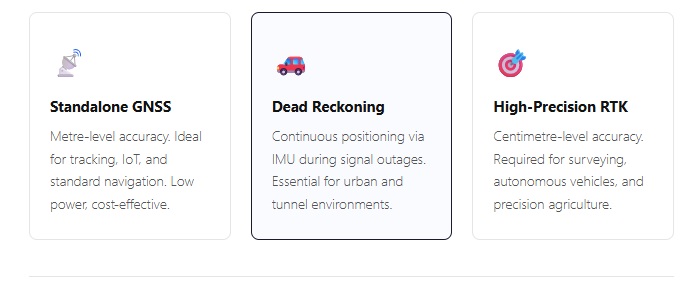
The Three GNSS Module Categories
Standalone GNSS
Metre-level accuracy. Ideal for tracking, IoT, and standard navigation. Low power, cost-effective.
🚗
Dead Reckoning
Continuous positioning via IMU during signal outages. Essential for urban and tunnel environments.
🎯
High-Precision RTK
Centimetre-level accuracy. Required for surveying, autonomous vehicles, and precision agriculture.
Standalone GNSS Modules
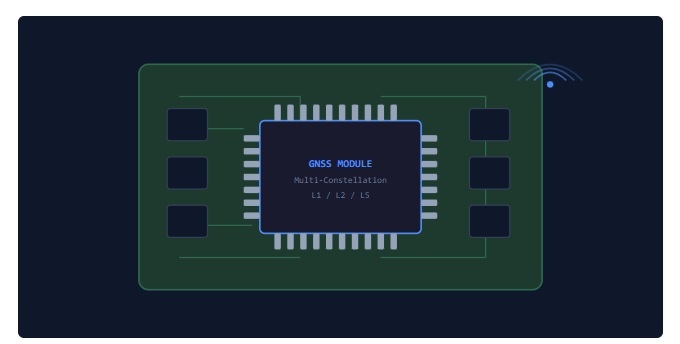
A typical GNSS receiver module with multi-constellation support
Standalone GNSS modules are ideal for applications that require accurate positioning without additional communication or sensor integration. These modules feature an integrated GNSS receiver and antenna, enabling them to independently acquire and process satellite signals.
Typical Applications
Asset tracking and monitoring
Personal navigation devices
Location-based services
Basic telematics systems
IoT positioning applications
Key Benefits
Cost-effective implementation
Low power consumption
Fast Time-to-First-Fix (TTFF)
Support for GPS, Galileo, GLONASS, and BeiDou
Reliable metre-level positioning accuracy
Standalone GNSS modules deliver dependable positioning performance for a wide range of industrial and commercial applications where standard navigation accuracy is sufficient.
Dead Reckoning GNSS Modules
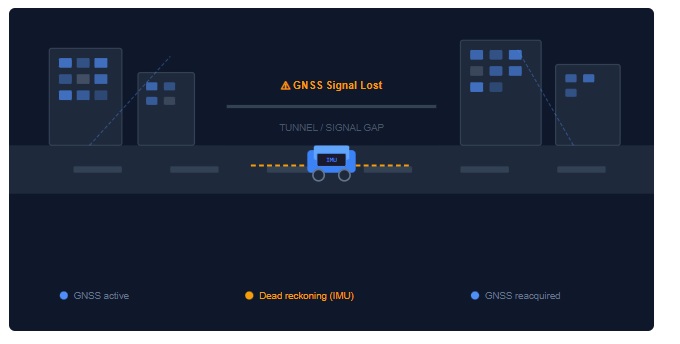
Dead reckoning uses onboard IMU sensors to maintain positioning continuity through tunnels and urban canyons
In environments where satellite signals may be obstructed or temporarily unavailable, dead reckoning GNSS modules provide enhanced positioning continuity. These solutions combine GNSS technology with inertial measurement sensors (IMUs) to estimate and maintain position during periods of signal degradation or loss.
Typical Applications
Fleet management
Vehicle telematics
Urban navigation systems
Logistics and delivery vehicles
Connected automotive systems
Ideal Environments
Urban canyons
Tunnels and underground parking facilities
Dense forests and foliage
Industrial facilities with intermittent GNSS coverage
Key Benefits
Continuous positioning during signal outages
Improved navigation reliability
Enhanced route accuracy in dense urban environments
Seamless transition between GNSS and inertial navigation
Dead reckoning GNSS modules ensure consistent and dependable location tracking, making them particularly valuable for applications that require uninterrupted positioning data.
High-Precision GNSS Modules
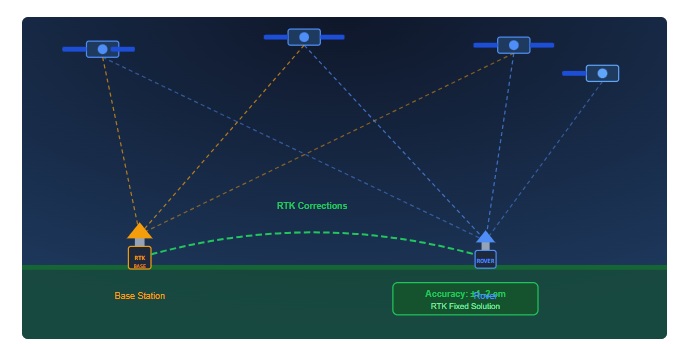
RTK positioning uses corrections broadcast from a base station to achieve centimetre-level accuracy at the rover
For applications where positioning accuracy is mission-critical, high-precision GNSS modules offer advanced capabilities and exceptional performance. Leveraging Real-Time Kinematic (RTK) positioning, these modules can achieve centimetre-level accuracy in real time.
Typical Applications
Land surveying and mapping
Precision agriculture
Construction and machine control
Autonomous vehicles and robotics
Infrastructure monitoring
Unmanned aerial vehicles (UAVs)
Key Benefits
Centimetre-level positioning accuracy
Multi-frequency GNSS support
Faster RTK convergence times
Improved performance in challenging environments
Enhanced reliability for mission-critical operations
High-precision GNSS systems typically require correction data from an RTK base station or NTRIP correction service to achieve their highest levels of accuracy.
Matching GNSS Technology to Your Application
Use Case
Recommended Module
Accuracy
Key Feature
Asset tracking / IoT
Standalone GNSS
Metre-level
Low power, low cost
Fleet & vehicle telematics
Dead Reckoning
Metre-level
IMU continuity
Urban navigation
Dead Reckoning
Metre-level
Signal gap bridging
Surveying & mapping
High-Precision RTK
Centimetre-level
RTK fixed solution
Precision agriculture
High-Precision RTK
Centimetre-level
Multi-frequency
Autonomous vehicles
High-Precision RTK
Centimetre-level
Fast convergence
UAVs / robotics
High-Precision RTK
Centimetre-level
Heading initialisation
Additional Integration Considerations
Antenna Selection
High-precision applications typically require active, high-performance GNSS antennas to maximise signal quality and positioning accuracy.
Time-to-First-Fix (TTFF)
Applications requiring rapid startup should prioritise modules with fast acquisition performance, Real-Time Clock (RTC) backup, and Assisted GNSS (A-GNSS) support.
Multi-Constellation Support
Modern GNSS modules that support multiple satellite constellations — GPS, Galileo, GLONASS, BeiDou — provide improved availability, reliability, and positioning accuracy across diverse operating environments.
The Bottom Line
Selecting the right GNSS module is a critical step in building a reliable and effective positioning solution. Whether your application requires basic tracking, uninterrupted navigation in challenging environments, or ultra-precise location data, the right technology choice directly impacts operational outcomes.
Choose a Standalone GNSS Modulefor standard positioning and tracking applications.
Choose a Dead Reckoning GNSS Modulewhen continuous positioning is needed in areas with frequent signal interruptions.
Choose a High-Precision RTK GNSS Modulewhen centimetre-level accuracy is essential for operational success.
By carefully evaluating accuracy requirements, operating environment, frequency band, power consumption, and continuity needs, organisations can choose a GNSS solution that delivers optimal performance and long-term value.
If you are unsure which GNSS technology best fits your application, consulting with a GNSS specialist can help identify the ideal solution for your specific operational requirements.
Linfinity GNSS is a Cambridge-based team of precision positioning engineers with 20+ years of hands-on GNSS integration and testing experience. We work with organisations across maritime, defence, automotive, and autonomous systems.
Linfinity GNSS is a Cambridge-based team of precision positioning engineers with 20+ years of hands-on GNSS integration and testing experience. We work with organisations across maritime, defence, automotive, and autonomous systems.
In today’s rapidly evolving industrial landscape, connectivity plays a critical role in driving efficiency, productivity, and operational visibility. From asset tracking and fleet management to autonomous systems and precision agriculture, accurate positioning data is essential for informed decision-making and streamlined operations. At the heart of these solutions is the Global Navigation Satellite System (GNSS) module…
Field testing GNSS firmware used to mean weeks of manual driving routes, spreadsheet analysis, and expert sign-off on gut instinct. The scale of modern GNSS product development — multiple product families, growing firmware complexity, and customers demanding granular pass/fail evidence — has made that model untenable.
At LinfinityGNSS Ltd, we’re building a different approach: an intelligent, automated testing framework that combines real-world RF capture, repeatable lab replay, and AI-driven analysis to ensure every firmware release meets the quality bar our customers expect — before it ever reaches them.
This article covers how we think about GNSS testing at scale, how the automated system works, and — critically — where AI is already improving the process and where it will transform it next.
1
Why GNSS Testing Is So Hard to Scale
Modern GNSS positioning products are no longer simple receivers. They power autonomous vehicles, precision agriculture, maritime navigation, drones, and consumer wearables — each with different performance requirements and dramatically different operating environments.
Testing a firmware release properly means covering:
Field testing — urban, dense urban, highway, tunnel exit, sport scenarios (swimming, running), technology-specific environments (drones, lawnmowers), and pedestrian use cases
System validation — full SW/HW regression, safety-critical standards compliance, and release gating
Hardware testing — module-level checks, reliability (jamming, spoofing), MTBF, stress, and production quality
Four forces are making this harder with every release cycle:
Log complexity: different log formats per product, and a very high number of products
Customer expectations: increasingly granular pass/fail documentation required by both internal and external stakeholders
Release velocity: the volume of tests associated with each validation cycle continues to grow
Analysis depth: manual log review cannot scale — automated parsing and structured output is now a requirement, not a nice-to-have
2
The Record & Replay Foundation
The centrepiece of our field testing methodology is the Spirent GSS6450 RF Record & Playback System. It captures real-world GNSS, cellular, and wireless RF signals in the field — including RTK corrections and Dead Reckoning data — and reproduces them with full fidelity in the laboratory.
This changes the economics and repeatability of firmware validation. Instead of re-driving test routes every time a new build is ready, teams replay a curated library of gold-standard recordings against every firmware version. The signal environment is identical. The comparison is objective. The result is true repeatability at scale.
Key benefits:
Capture data across diverse geographies — not just one region — to ensure algorithms perform reliably worldwide
Train positioning algorithms with real RTCM corrections and replay the data as many times as needed
Enable genuine benchmarking between different firmware versions, hardware variants, and competing products
Re-collect logs from the field if a new edge case is discovered, without repeating the entire test campaign
AI Enhancement
LLM-based classifiers can be applied at ingestion time to automatically tag and categorise recorded scenarios — classifying signal complexity, environment type, multipath severity, and likely failure modes. This allows the system to prioritise the most diagnostically valuable replays in regression runs, rather than running everything every time.
3
The Automated Testing System — How It Works
The automated testing platform is built around a self-service web interface. From a browser, a user selects the configuration — module type, firmware version, hardware variant, test scenario — and the system handles everything else.
The workflow is as follows:
Step 1 — Configure. Select module type, firmware version, hardware configuration, and test scenario from the web dashboard.
Step 2 — Orchestrate. The system automatically fetches the replay file and configuration from the central database, then communicates with the GSS6450 to begin the RF replay.
Step 3 — Analyse. Logs are automatically ingested and parsed against KPI thresholds the moment the replay completes.
Step 4 — Report. A structured, colour-coded pass/fail report is generated and delivered by email — no manual intervention required.
AI Enhancement
AI agents embedded in the orchestration layer can dynamically select the most relevant test scenarios for a given firmware diff — analysing the code changes and recommending targeted regression coverage rather than running the full suite every time. This can reduce test cycle time by 40–60% without reducing defect detection sensitivity.
4
Reporting: Beyond Pass/Fail
Test reports are not simple binary summaries. They are structured intelligence documents covering multiple DUTs (Devices Under Test) across different firmware, hardware, and configuration variants, with truth data from the original field collection as the immutable reference baseline.
Reports include both common KPIs — applied universally across all products — and differentiated KPIs, which are specifically designed for each test scenario and product family. Results are colour-coded:
Result
Colour
Meaning
PASS
Green
Result within acceptable limits for this KPI
LIMIT
Orange
Result near boundary — warrants close review before sign-off
FAIL
Red
Result outside acceptable limits — blocks release or requires root cause
AI Enhancement
Natural language generation models can transform raw KPI data into plain-English failure narratives — automatically explaining why a test failed, which signal conditions contributed, and which firmware components are likely implicated. Engineers spend their time on root cause and fixes, not interpreting data tables.
5
Where AI Takes This Further
The platform described above is a strong foundation. What follows is the AI-driven roadmap that will define the next generation of GNSS quality assurance.
Predictive failure detection via ML on log history
Train anomaly-detection models on the growing historical log database to identify subtle signal patterns that precede known failure modes — surfacing regression risks before they manifest as customer complaints. The model improves with every release cycle, building institutional memory that no human team could maintain alone.
AI-augmented distributed testing
Expand field coverage by engaging FAE teams and volunteers across global locations to contribute real-world recordings on a regular basis. An AI routing layer automatically classifies incoming data, detects duplicates, and prioritises novel signal environments — ensuring the test corpus grows in quality, not just volume.
Intelligent regression scope optimisation
Apply LLM-based code analysis to each firmware diff to automatically recommend a targeted regression test plan, covering the most likely impact areas without running the full suite. This compresses release cycles without compromising coverage, making continuous delivery viable even for safety-relevant products.
Conversational test intelligence
Embed a conversational AI interface into the reporting platform — allowing engineers, FAEs, and product managers to query test results in plain language. “Which firmware version had the worst urban tunnel re-acquisition performance in the last three releases?” becomes a one-sentence question, not a three-hour data archaeology exercise.
Generative scenario synthesis
Use generative models to synthesise novel, edge-case RF scenarios that are statistically rare in real-world collections but known to stress positioning algorithms — automatically expanding test coverage into corners of the signal space that field teams would never encounter organically.
6
Stakeholder Reporting Flow
Technology alone is not enough. Test outcomes must reach the right people in the right form. The reporting workflow is structured as follows:
New feature testing — conducted by the ST Team with focused analysis on the integrated feature
Regression testing — a predefined set of tests per product, evolving alongside the product itself
Report review — the ST Team analyses failures and provides context before sharing outward
Distribution — reports shared with FAE, R&D, and PDM teams, the stakeholders closest to customer requirements
This flow ensures test results are actionable — not a data dump, but a curated, decision-ready briefing for each audience.
The Bottom Line
The combination of real-world RF record & replay, web-based test orchestration, automated KPI reporting, and AI-driven intelligence represents a genuine step-change in what GNSS quality assurance can achieve.
Every release cycle is a learning opportunity. Organisations that build systems to capture and act on that learning — making the test infrastructure smarter with every run — will out-quality their competitors permanently. At LinfinityGNSS Ltd, that is exactly what we are building.
If you are planning a GNSS validation programme, scaling a test team, or want to understand how AI can improve your existing testing process, we’re happy to discuss it.
Talk to a GNSS testing expert — whether it’s reviewing your test strategy, helping design KPI frameworks, or integrating record & replay into your workflow, we’re here to help.Consult an expert →Or email us: info@linfinityGNSS.com
Silvana Capasso worked as GNSS test engineer at Intel for >10 years and now she is the co-founder of LinfinityGNSS Ltd, a Cambridge-based team of precision positioning engineers with 20+ years of hands-on GNSS integration and testing experience. We work with organisations across automotive, maritime, and autonomous systems.
GNSS Technical Articles By LinfinityGNSS·8 June 2026·9 min read Field testing GNSS firmware used to mean weeks of manual driving routes, spreadsheet analysis, and expert sign-off on gut instinct. The scale of modern GNSS product development — multiple product families, growing firmware complexity, and customers demanding granular pass/fail evidence — has made that model untenable.…
If you work with positioning systems, you will have seen the terms “multi-constellation” and “multi-frequency” used frequently. But what do they actually mean in practice, and why do they matter for real-world deployments? This article breaks it down from first principles.
GPS vs. GNSS: What’s the Difference?
The terms are often used interchangeably, but they are not the same thing. GPS (Global Positioning System) is one specific satellite navigation system, operated by the US Space Force. GNSS (Global Navigation Satellite System) is the umbrella term covering all satellite navigation systems worldwide.
A GPS-only receiver draws signals from a single constellation. A GNSS receiver can simultaneously process signals from multiple independent constellations — GPS, Galileo, GLONASS, BeiDou, QZSS, and NavIC — giving it access to far more satellites at any given moment.
System
Operator
Operational Satellites
Coverage
GPS
USA
31
Global
Galileo
Europe (ESA/EU)
28 (36 planned)
Global
BeiDou-3
China
48
Global
GLONASS
Russia
23
Global
QZSS
Japan
4
Japan & Asia-Pacific
NavIC
India
7
India & surrounding region
As of 2026, there are approximately 130–135 active GNSS satellites in orbit across the four global systems alone. A receiver with access to all constellations may see 30–40 or more satellites simultaneously — compared to 8–10 for GPS only. That difference in satellite count has a direct and significant effect on positioning performance.
What Does Multi-Frequency Add?
Each GNSS satellite transmits on one or more radio frequencies. Consumer navigation devices — the GPS in a phone or a car — typically use a single frequency (L1). Dual-frequency receivers add a second signal per satellite. True multi-frequency professional receivers track a wide set of signals across all constellations simultaneously.
The more signals a receiver can access, the more independent data points it has for computing position. More data points mean more redundancy, better error detection, and a position solution that holds together under pressure.
Performance in Difficult Environments
A GNSS receiver needs signals from at least four satellites to compute a position fix. In open sky, that is straightforward. In real deployments it rarely is. Construction sites, urban environments, dense forest canopy, and industrial facilities all block significant portions of the sky, reducing visible satellite count considerably.
Multi-constellation receivers address this directly. By drawing from every available satellite system, they maintain a high satellite count even when large sky sectors are obstructed — keeping accurate positioning available in conditions where a GPS-only receiver would lose fix entirely.
For situations where the sky view is completely blocked — under bridges, tunnels, or thick canopy — a GNSS/INS (Inertial Navigation System) integration bridges the gap. The inertial sensor computes relative position from the last known GNSS fix, maintaining continuity until satellite signals are reacquired.
Seven Key Advantages of Multi-Frequency GNSS
Better accuracy. Access to more satellites creates statistical redundancy. This enables the receiver to detect and reject faulty range signals, improving the overall accuracy of the computed position beyond what any single-frequency system can achieve.
Removal of ionospheric errors. Charged particles in the ionosphere delay GNSS signals in ways that vary with atmospheric conditions. When a receiver can access two or more signals from the same satellite, it can mathematically cancel the dominant ionospheric error — reducing stand-alone positional error from several metres to under one metre.
Radiofrequency interference robustness. RF interference typically targets one frequency band at a time. A multi-frequency receiver can shift processing to unaffected frequencies when interference is detected on one band, maintaining lock where a single-frequency receiver would fail completely.
Better multipath rejection. The L1 signal used in single-frequency receivers is particularly susceptible to multipath — signal reflections from buildings, vehicles, and terrain that introduce ranging errors. Newer signals such as GPS L5, Galileo L1BC, and Galileo E5-AltBoc are inherently more resistant to multipath. Advanced receiver algorithms add a further layer of mitigation on top of this.
Additional spoofing detection. By cross-checking range information across multiple frequencies simultaneously, a receiver can flag inconsistencies that indicate a spoofing attack. This is an important layer of defence for any security-critical application. A single-frequency receiver has no equivalent check available.
Full RTK network compatibility. RTK correction networks broadcast corrections tied to specific signals — for example, E5b rather than E5a. Only receivers that track all signals are fully compatible with every available RTK network. A receiver with limited signal coverage may not be able to use corrections from a given network at all.
Fast RTK fix and heading initialisation. A single-frequency receiver may take several minutes to achieve RTK fix after signal loss. Multi-frequency receivers can re-converge in seconds. In dynamic work environments where the receiver regularly enters and leaves obstructed areas, this difference in reacquisition time has a direct operational impact.
Upcoming GNSS Services: A Note on Future-Proofing
Several GNSS agencies are rolling out new value-added services delivered directly via satellite signals — no additional subscription hardware required, and most will be offered free of charge. A multi-frequency receiver deployed today will be ready to use these services as soon as they become available.
Service
Benefit
System
Signal
Region
Status
OSNMA
Anti-spoofing
Galileo
E1b
Global
Operational Beta
Galileo HAS
~20 cm accuracy
Galileo
E6
Global
Nearing Beta
QZSS CLAS
Sub-decimetre accuracy
QZSS
L6
Japan
Operational
BeiDou PPP-B2b
~20 cm accuracy
BeiDou
B2b
China
Operational Beta
GPS Chimera
Anti-spoofing
GPS
L1C
Global
Not yet operational
Galileo CAS
Commercial anti-spoofing
Galileo
E6
Global
Not yet operational
The Bottom Line
For any application where positioning accuracy, availability, and resilience are requirements — surveying, precision agriculture, autonomous machinery, construction, UAVs, maritime, and industrial robotics — the case for multi-frequency, multi-constellation GNSS is straightforward.
More constellations means more visible satellites and higher positioning availability in obstructed environments. More frequencies means better ionospheric correction, stronger interference resilience, faster convergence, and additional spoofing detection capability. And choosing a future-proof multi-frequency receiver today means being ready to exploit the wave of free high-accuracy services coming online in the next few years.
Single-frequency, single-constellation GPS was sufficient for a generation of applications. For the positioning challenges organisations are tackling now, it is not.
If you are specifying, integrating, or evaluating GNSS receivers and want an independent view on what capability level is appropriate for your application, we are here to help.
Linfinity GNSS is a Cambridge-based team of precision positioning engineers with 20+ years of hands-on GNSS integration and testing experience. We work with organisations across maritime, defence, automotive, and autonomous systems.
By Linfinity GNSS | 8 min read | 8 June 2026 If you work with positioning systems, you will have seen the terms “multi-constellation” and “multi-frequency” used frequently. But what do they actually mean in practice, and why do they matter for real-world deployments? This article breaks it down from first principles. GPS vs. GNSS:…
Spirent simulators are the gold standard for GNSS receiver testing. The GSS7000, GSS9000, and their predecessors have been used to qualify receivers for everything from consumer devices to defence-grade navigation systems. When used well, they give you repeatable, controllable test conditions that live-sky testing simply can’t match.
When used poorly, they give you false confidence — and receivers that pass the lab but fail in the field.
After 20+ years of GNSS integration and testing work, here are the mistakes we see most often.
1. Not Accounting for the RF Cable Loss Budget
This is the most common and most damaging mistake. GNSS signals arrive at your antenna at around -130 dBm — already extremely weak. The moment you introduce an RF cable between your Spirent output and your receiver under test, you’re attenuating that signal further.
Engineers frequently connect a Spirent output directly to a receiver via whatever cable is to hand, without measuring or compensating for the loss. A 5 dB loss in the cable means the receiver is seeing a significantly weaker signal than the simulator intended — your C/N₀ figures are wrong, your acquisition times are artificially degraded, and your test results don’t reflect the scenario you thought you were simulating.
Fix: Always measure your cable loss before running a test. Enter the measured loss into Spirent’s signal power offset so the simulator compensates. For longer cable runs, use a low-loss cable and a calibrated inline amplifier.
2. Ignoring the Antenna Gain Pattern
Spirent simulators output signals that represent satellites at specific azimuth and elevation angles. But most bench test setups feed that signal directly into the receiver’s RF input — bypassing the antenna entirely.
In the real world, your antenna has a gain pattern. A satellite at 10° elevation looks very different to your receiver than one at 80° elevation, because the antenna attenuates low-elevation signals. If your test doesn’t model this, you’re testing a receiver that sees all satellites equally — which never happens in deployment.
Fix: Either use Spirent’s antenna modelling feature (available on higher-end systems) to apply a measured antenna pattern to the simulation, or be explicit in your test report that antenna effects are excluded and account for this in your field validation plan.
3. Using Default Simulation Scenarios Uncritically
Spirent ships with a library of default scenarios. They’re very useful for getting started, but they’re not exactly a substitute for a scenario matched to your actual deployment environment.
The default scenarios typically simulate ideal open-sky conditions with a clean constellation. If your product is going into a maritime environment, an urban canyon, a forest canopy, or a high-dynamic aircraft, the default scenario tells you almost nothing about how it will actually perform.
Fix: Build custom scenarios that reflect your real operational environment. This means correct geographic location, correct time of year (constellation geometry varies), correct dynamics (static, pedestrian, vehicle, aircraft), and appropriate signal degradation (multipath, atmospheric models). Spirent’s SimGEN or MANIAC software gives you full control — use it.
4. Not Validating the Simulator Output Before Testing
Simulators are complex RF systems. Firmware updates, hardware faults, connector wear, and misconfiguration can all cause a Spirent to output something other than what you think it’s outputting.
We’ve seen test campaigns invalidated because nobody verified the simulator’s output with a known-good reference receiver before starting. The receiver under test was blamed for poor performance that was actually a simulator configuration error.
Fix: Before every test campaign, connect a known-good reference receiver to the Spirent output and verify that it acquires the expected constellation, reports the expected position, and shows healthy C/N₀ values across all channels. Log this as your baseline. It takes 10 minutes and has saved us from very expensive mistakes.
Also make sure you have the latest Spirent FW version that include all the required fixes
5. Overlooking Multipath Simulation
Real-world GNSS environments are full of reflected signals. Urban buildings, ship superstructures, vehicle bodywork, and ground reflections all create multipath — signals that arrive at the antenna via indirect paths, causing ranging errors.
A simulation without multipath will make almost any receiver look good. Add realistic multipath and the picture changes dramatically, particularly for low-cost receivers that lack robust multipath mitigation.
Fix: Use Spirent’s multipath simulation capabilities to add reflected signals at appropriate delays and power levels for your target environment. For maritime testing, model reflections from the vessel superstructure. For urban testing, use a ray-tracing model if available, or manually add reflectors at representative geometry.
6. Testing Only Steady-State Performance
Many test plans focus on steady-state accuracy — how well does the receiver perform once it has a stable fix under nominal conditions? This is important, but it misses the failure modes that matter most in deployment.
What happens during initial cold start? How quickly does the receiver reacquire after a signal outage? How does it behave during a high-dynamic manoeuvre? What happens at the edge of the visibility mask when satellites are rising and setting?
Fix: Structure your test plan around transitions and corner cases, not just steady/simple state. Include cold start, warm start, and hot start scenarios. Simulate signal outages of varying duration. Test at the boundaries of your operational envelope — maximum speed, maximum acceleration, minimum satellite visibility.
7. Not Testing Interference Scenarios
If your receiver will be deployed anywhere near RF-noisy environments — and most will — testing it in a clean simulation environment gives you an incomplete picture.
Spirent systems support the injection of interference signals: wideband noise, narrowband CW interference, chirp jammers, and (on appropriate systems) spoofing scenarios. Most teams don’t use these capabilities because setting them up takes more effort. That effort is worth it.
Fix: Define the interference environment your product will actually encounter. A maritime receiver needs to be tested against the RF environment of a working vessel — radar, AIS, VHF comms, satellite comms all coexist in a noisy RF environment. An automotive receiver will encounter LTE and 5G interference from nearby devices. Characterise the interference, model it in Spirent, and test against it.
8. Treating Lab Results as Field Validation
This is the overarching mistake that all the others contribute to. A Spirent simulation, however well designed, is a model of the world — not the world itself. It can’t capture everything: antenna installation effects, vehicle body shielding, local RF environment, real atmospheric conditions on a specific day, or the interaction between your GNSS receiver and the rest of your system’s electronics.
Lab results tell you your receiver is capable of meeting your requirements under controlled conditions. They do not tell you it will meet them in the field.
Fix: Plan for a structured live-sky validation phase after lab testing. Use the lab results to define what you’re looking for in the field — specific metrics, specific scenarios — and then go verify them. Treat discrepancies between lab and field results as data, not anomalies to be explained away.
Getting the Most from Your Spirent Investment
Spirent simulators are expensive and great pieces of testing equipment. The teams that get the most value from them are the ones that invest as much thought in test design as they do in the hardware itself — building scenarios that reflect reality, validating their setup before every campaign, and treating lab testing as one part of a broader validation strategy rather than the whole story.
If you’re planning a GNSS receiver test campaign and want to pressure-test your approach, or if you’re seeing results that don’t make sense, we’re happy to take a look.
Linfinity GNSS is a Cambridge-based team of precision positioning engineers with 20+ years of hands-on GNSS integration and testing experience. We work with organisations across maritime, defence, automotive, and autonomous systems.
Written by LinfinityGNSS in GNSS Technical Articles Spirent simulators are the gold standard for GNSS receiver testing. The GSS7000, GSS9000, and their predecessors have been used to qualify receivers for everything from consumer devices to defence-grade navigation systems. When used well, they give you repeatable, controllable test conditions that live-sky testing simply can’t match. When…