
Expert support for GNSS integration & testing in real-world environments, from prototyping to deployment — helping engineering teams validate positioning performance before it ever reaches a customer.
Bringing a GNSS-enabled product to market means navigating a complex mix of hardware, firmware, signal environments, and edge cases that rarely show up in a lab. Our GNSS integration & testing services help you close that gap — validating performance early, catching issues before they become costly, and giving you confidence in the field.
Firmware quirks
Behaviour shifts once a receiver leaves the bench.
Antenna placement
Installation and siting affect signal quality.
Correction data quality
Feeds accuracy under RTK and PPP-RTK.
Local RF conditions
Multipath and interference vary by site.
Whether you’re building a new receiver, integrating a GNSS module into a larger system, or validating an existing deployment, we work alongside your engineering team to de-risk the process and accelerate time to market. Where useful, we also draw on GASP, our AI-powered GNSS platform, to speed up log review and pattern-matching across large test datasets — a fast way to get a first read on your challenge before we dig in properly.
What We Help With
From first prototype to production hardware, support at every stage of the GNSS integration & testing process.
Hardware & software integration
Support for integrating GNSS receivers, antennas, and modules into your product architecture — including interface design, driver configuration, and system-level compatibility checks. See our guide to choosing the right GNSS module for your application.
Field & environmental testing
Real-world testing across diverse conditions — urban canyons, marine environments, industrial sites, and automotive scenarios — to validate performance where it actually matters, not just where it’s convenient to test.
Signal analysis & log review
Detailed analysis of GNSS logs and signal data to identify performance issues, multipath effects, jamming or spoofing indicators, and other anomalies affecting accuracy or reliability.
Prototype-to-production support
Guidance through every stage of development, from early proof-of-concept testing to pre-deployment validation and certification readiness, informed by AI-powered field test automation where it speeds up iteration.
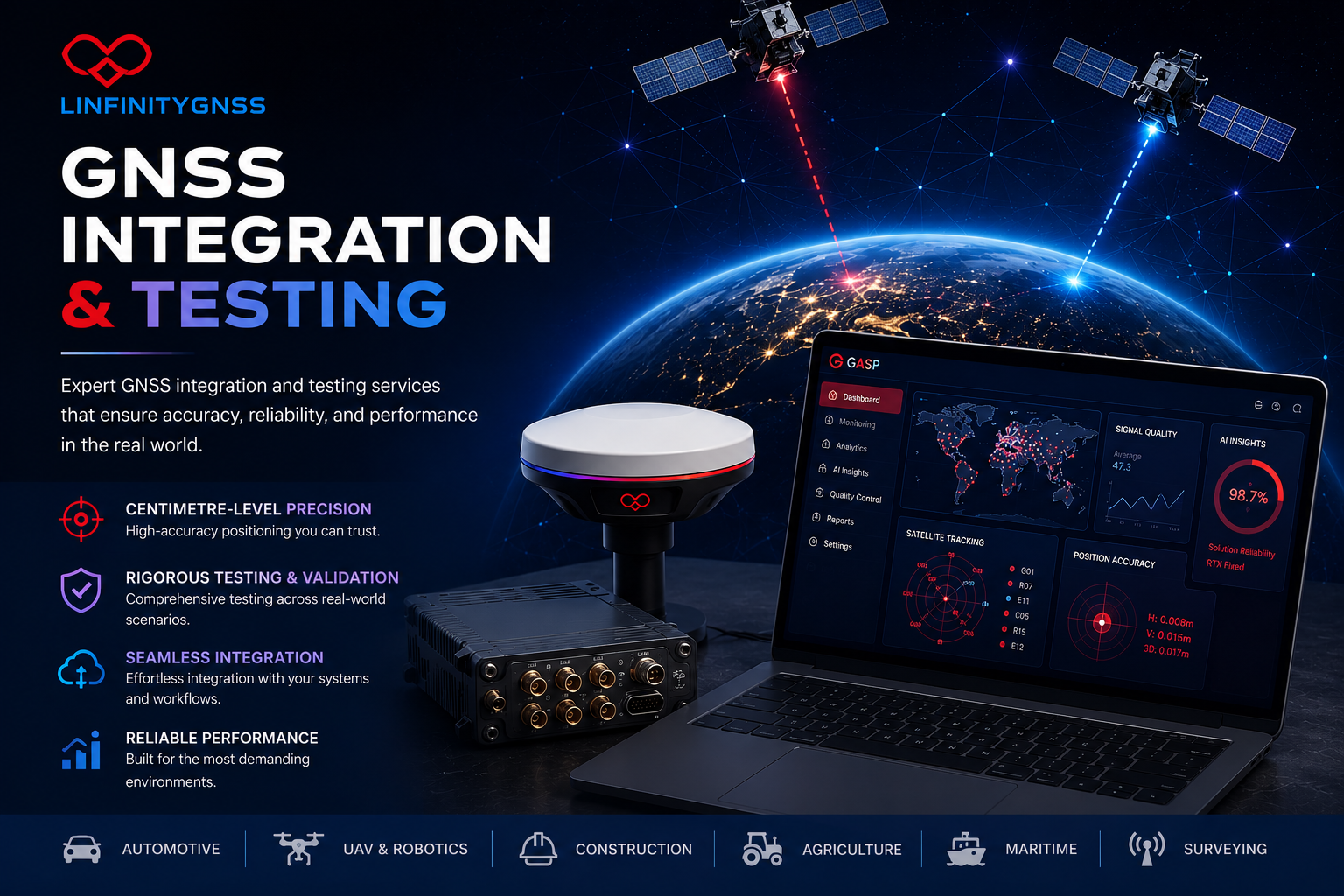
Integration and testing in practice — from bench setup to real-world signal conditions.
Performance Benchmarking
Objective testing against industry standards and your own requirements, so you know exactly how your system performs before it ships. Benchmarking covers metrics such as time-to-first-fix and positioning accuracy under varying satellite geometry, tracking sensitivity, and resilience to signal degradation.
Where correction data is part of the picture, we also assess how well your system performs against RTK and PPP-RTK correction services, so accuracy claims hold up outside the lab as well as inside it.
Who We Work With
Engineering teams building GNSS-dependent products across maritime, automotive, industrial, and other positioning-critical sectors — from early-stage startups validating a first prototype to established manufacturers testing production hardware. Many of these teams also come to us for anti-jam & anti-spoof testing, since integration testing and threat resilience are closely linked in positioning-critical systems. A number of them first found us through our GNSS integration & testing community.
Why It Matters
GNSS performance issues that go undetected until deployment are expensive to fix and can damage trust in your product. Testing early and testing in realistic conditions is the difference between a system that performs well in the lab and one that performs well everywhere your customers actually use it. It’s also worth remembering that a valid-looking position fix doesn’t always mean a correct one — thorough testing is what catches the failures that don’t trigger an obvious alarm. If you’re weighing up where GNSS integration & testing fits into your own roadmap, we’re happy to talk it through.
Related Reading
A few technical articles that pair well with our integration & testing work.
Get Started
Have a project in mind, or unsure where to start?