

By Linfinity GNSS | 8 min read | 8 June 2026
If you work with positioning systems, you will have seen the terms “multi-constellation” and “multi-frequency” used frequently. But what do they actually mean in practice, and why do they matter for real-world deployments? This article breaks it down from first principles.
GPS vs. GNSS: What’s the Difference?
The terms are often used interchangeably, but they are not the same thing. GPS (Global Positioning System) is one specific satellite navigation system, operated by the US Space Force. GNSS (Global Navigation Satellite System) is the umbrella term covering all satellite navigation systems worldwide.
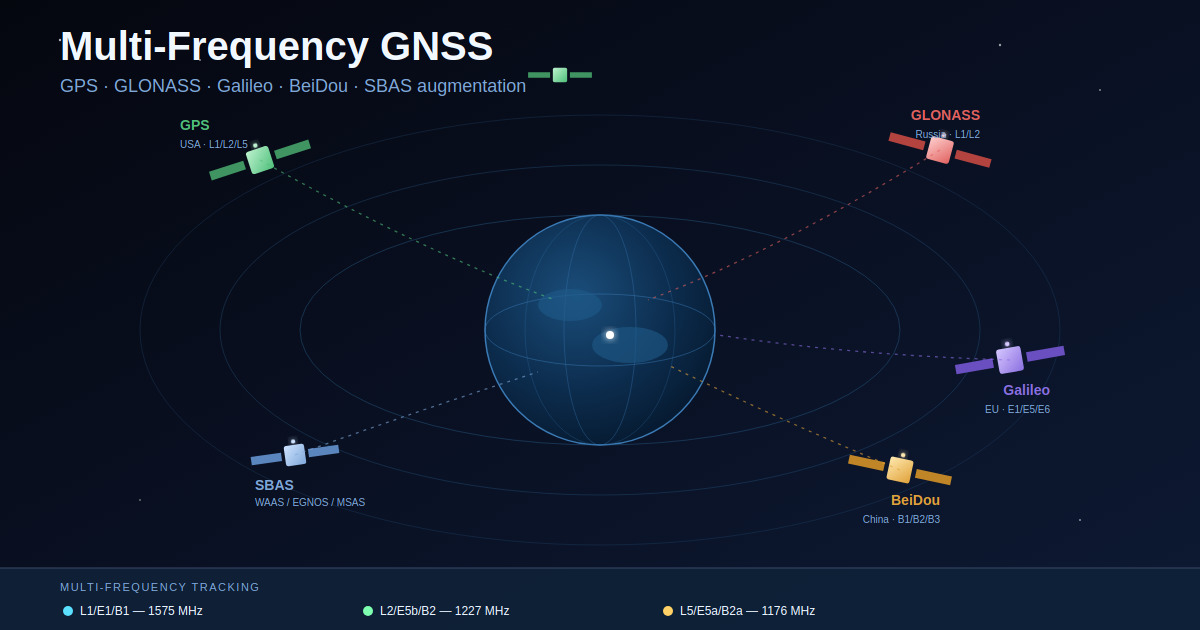
A GPS-only receiver draws signals from a single constellation. A GNSS receiver can simultaneously process signals from multiple independent constellations — GPS, Galileo, GLONASS, BeiDou, QZSS, and NavIC — giving it access to far more satellites at any given moment.
| System | Operator | Operational Satellites | Coverage |
|---|---|---|---|
| GPS | USA | 31 | Global |
| Galileo | Europe (ESA/EU) | 28 (36 planned) | Global |
| BeiDou-3 | China | 48 | Global |
| GLONASS | Russia | 23 | Global |
| QZSS | Japan | 4 | Japan & Asia-Pacific |
| NavIC | India | 7 | India & surrounding region |
As of 2026, there are approximately 130–135 active GNSS satellites in orbit across the four global systems alone. A receiver with access to all constellations may see 30–40 or more satellites simultaneously — compared to 8–10 for GPS only. That difference in satellite count has a direct and significant effect on positioning performance.
What Does Multi-Frequency Add?
Each GNSS satellite transmits on one or more radio frequencies. Consumer navigation devices — the GPS in a phone or a car — typically use a single frequency (L1). Dual-frequency receivers add a second signal per satellite. True multi-frequency professional receivers track a wide set of signals across all constellations simultaneously.
The more signals a receiver can access, the more independent data points it has for computing position. More data points mean more redundancy, better error detection, and a position solution that holds together under pressure.
Performance in Difficult Environments
A GNSS receiver needs signals from at least four satellites to compute a position fix. In open sky, that is straightforward. In real deployments it rarely is. Construction sites, urban environments, dense forest canopy, and industrial facilities all block significant portions of the sky, reducing visible satellite count considerably.
Multi-constellation receivers address this directly. By drawing from every available satellite system, they maintain a high satellite count even when large sky sectors are obstructed — keeping accurate positioning available in conditions where a GPS-only receiver would lose fix entirely.
For situations where the sky view is completely blocked — under bridges, tunnels, or thick canopy — a GNSS/INS (Inertial Navigation System) integration bridges the gap. The inertial sensor computes relative position from the last known GNSS fix, maintaining continuity until satellite signals are reacquired.
Seven Key Advantages of Multi-Frequency GNSS
- Better accuracy. Access to more satellites creates statistical redundancy. This enables the receiver to detect and reject faulty range signals, improving the overall accuracy of the computed position beyond what any single-frequency system can achieve.
- Removal of ionospheric errors. Charged particles in the ionosphere delay GNSS signals in ways that vary with atmospheric conditions. When a receiver can access two or more signals from the same satellite, it can mathematically cancel the dominant ionospheric error — reducing stand-alone positional error from several metres to under one metre.
- Radiofrequency interference robustness. RF interference typically targets one frequency band at a time. A multi-frequency receiver can shift processing to unaffected frequencies when interference is detected on one band, maintaining lock where a single-frequency receiver would fail completely.
- Better multipath rejection. The L1 signal used in single-frequency receivers is particularly susceptible to multipath — signal reflections from buildings, vehicles, and terrain that introduce ranging errors. Newer signals such as GPS L5, Galileo L1BC, and Galileo E5-AltBoc are inherently more resistant to multipath. Advanced receiver algorithms add a further layer of mitigation on top of this.
- Additional spoofing detection. By cross-checking range information across multiple frequencies simultaneously, a receiver can flag inconsistencies that indicate a spoofing attack. This is an important layer of defence for any security-critical application. A single-frequency receiver has no equivalent check available.
- Full RTK network compatibility. RTK correction networks broadcast corrections tied to specific signals — for example, E5b rather than E5a. Only receivers that track all signals are fully compatible with every available RTK network. A receiver with limited signal coverage may not be able to use corrections from a given network at all.
- Fast RTK fix and heading initialisation. A single-frequency receiver may take several minutes to achieve RTK fix after signal loss. Multi-frequency receivers can re-converge in seconds. In dynamic work environments where the receiver regularly enters and leaves obstructed areas, this difference in reacquisition time has a direct operational impact.
Upcoming GNSS Services: A Note on Future-Proofing
Several GNSS agencies are rolling out new value-added services delivered directly via satellite signals — no additional subscription hardware required, and most will be offered free of charge. A multi-frequency receiver deployed today will be ready to use these services as soon as they become available.
| Service | Benefit | System | Signal | Region | Status |
|---|---|---|---|---|---|
| OSNMA | Anti-spoofing | Galileo | E1b | Global | Operational Beta |
| Galileo HAS | ~20 cm accuracy | Galileo | E6 | Global | Nearing Beta |
| QZSS CLAS | Sub-decimetre accuracy | QZSS | L6 | Japan | Operational |
| BeiDou PPP-B2b | ~20 cm accuracy | BeiDou | B2b | China | Operational Beta |
| GPS Chimera | Anti-spoofing | GPS | L1C | Global | Not yet operational |
| Galileo CAS | Commercial anti-spoofing | Galileo | E6 | Global | Not yet operational |
The Bottom Line
For any application where positioning accuracy, availability, and resilience are requirements — surveying, precision agriculture, autonomous machinery, construction, UAVs, maritime, and industrial robotics — the case for multi-frequency, multi-constellation GNSS is straightforward.
More constellations means more visible satellites and higher positioning availability in obstructed environments. More frequencies means better ionospheric correction, stronger interference resilience, faster convergence, and additional spoofing detection capability. And choosing a future-proof multi-frequency receiver today means being ready to exploit the wave of free high-accuracy services coming online in the next few years.
Single-frequency, single-constellation GPS was sufficient for a generation of applications. For the positioning challenges organisations are tackling now, it is not.
If you are specifying, integrating, or evaluating GNSS receivers and want an independent view on what capability level is appropriate for your application, we are here to help.
Or email us directly: info@linfinityGNSS.com
Linfinity GNSS is a Cambridge-based team of precision positioning engineers with 20+ years of hands-on GNSS integration and testing experience. We work with organisations across maritime, defence, automotive, and autonomous systems.
Leave a Reply